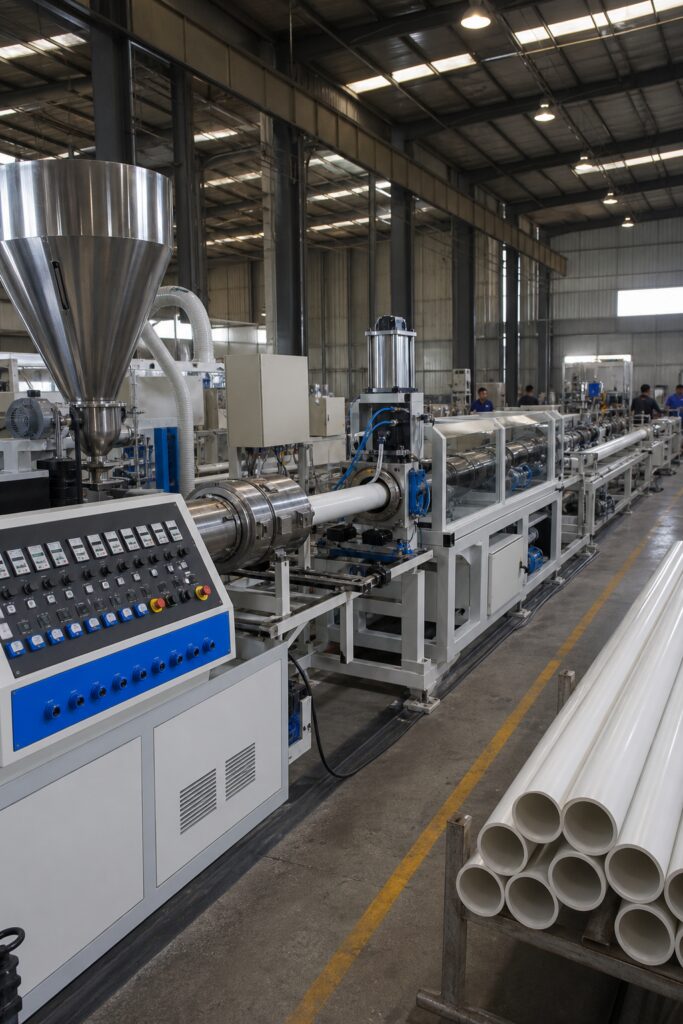
A PVC pipe manufacturing machine doesn’t work in isolation. It’s a linked sequence of stations, each one handing off to the next, and a problem at any single point shows up in every pipe that follows. Understanding how the line works, station by station, tells you where to intervene when output quality drops and what to ask when you’re comparing machines before buying.
PVC Pipe Manufacturing Line: Overall Layout and Key Components
A complete PVC pipe extrusion line runs in one direction, from raw material at the back to cut-length pipes at the front. The major stations, in order, are: the mixing and feeding unit, the extruder screw barrel, the die head, the vacuum calibration tank, the spray cooling tank, the haul-off machine, the printer, and the cutter. Most lines also include a tilting or stacking unit at the very end.
Each station is mechanically independent but electronically linked through a PLC control panel. Speed changes at the haul-off, for example, automatically adjust traction to match the extruder’s output rate. Wall thickness is a product of the ratio between extrusion speed and haul-off speed, so those two stations have to stay in sync at all times.
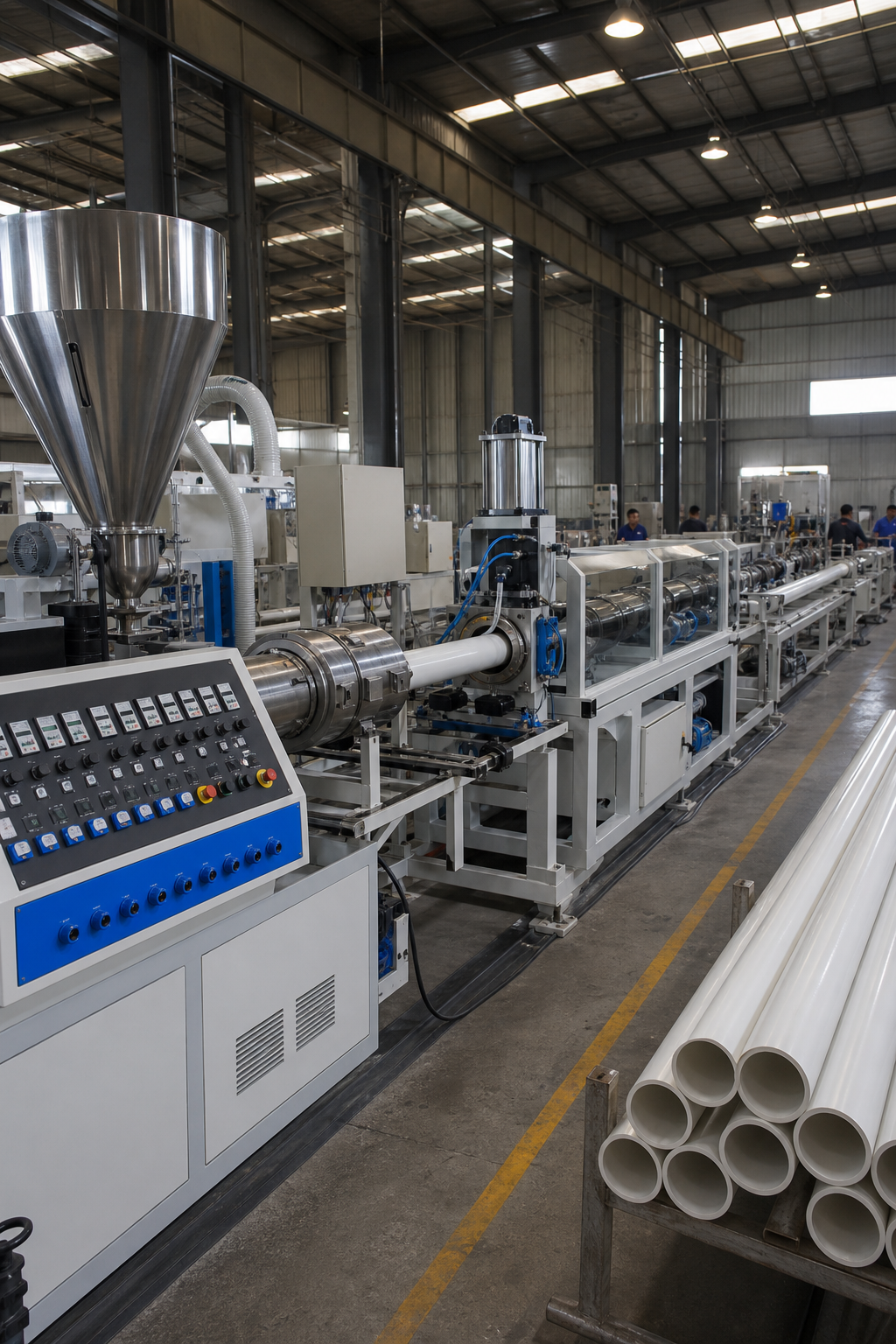
Pipe diameter range on a typical line runs from 16 mm up to 250 mm for small-bore schedules, and separate heavy-duty lines handle 315 mm to 630 mm or larger. Changing pipe diameter means swapping the die head tooling, the calibration sleeve, and the pipe support rollers in the cooling tanks. On modern lines that changeover takes two to four hours.
At Plastivo Extrusions, we build and supply complete PVC pipe making plants, including every station in the sequence above, designed for manufacturers across India, Kenya, Nigeria, South Africa, and the UAE. Our pipe making machine range covers both PVC and HDPE lines with fully automatic PLC operation.
Raw Material Feeding, Compounding, and Preparation
PVC resin on its own can’t be extruded. It’s a thermally sensitive polymer that degrades before it properly melts unless stabilizers are added first. A typical PVC compound for pipe production includes PVC resin (K-value 65, 67 for pressure pipe, 57, 60 for conduit), heat stabilizers (lead-based or calcium-zinc depending on the market and regulations), lubricants, calcium carbonate filler, and a small amount of titanium dioxide for color and UV resistance.
The mixing process happens in two stages. First, PVC resin and all the dry additives go into a high-speed mixer where friction heat brings the blend up to around 110, 120°C. This hot mix is then dropped into a cold mixer, which cools it back down to 40, 45°C while continuing to blend. The cold mixing step prevents the compound from agglomerating into lumps that would block the hopper or feed inconsistently into the screw.
After mixing, the dry blend moves to the extruder hopper by screw conveyor or vacuum loader. Some larger facilities compound the dry blend into pellets first using a separate twin-screw compounding line, then feed those pellets directly. Pelletized feed gives more consistent output but adds a processing step and cost. Most mid-scale pipe plants in Gujarat, Tamil Nadu, and Kerala run on dry blend fed directly to avoid that extra cost.
PVC is one of the most widely produced synthetic plastics globally, and its chemical structure makes additive formulation essential before melt processing.
One formulation detail buyers often overlook: the lubricant balance. Too much external lubricant causes slip at the barrel wall, reducing output. Too much internal lubricant lowers melt viscosity and can cause wall thinning. Getting this balance right for your specific resin grade is something Plastivo Extrusions can help you work out during line commissioning.
Extrusion: Screw Barrel, Heating Zones, and Melt Formation
The extruder is the thermal and mechanical core of the line. For PVC pipe, a conical twin-screw extruder is the standard choice. Two counter-rotating conical screws pick up the dry blend from the hopper, compress it, and progressively melt it as it travels toward the die head. The conical geometry gives a larger feed section and a smaller, lower-pressure discharge section, which suits PVC’s shear sensitivity well.
PVC can’t tolerate excessive shear heat. If the melt temperature climbs too high, HCl gas begins releasing from the polymer chain , that’s thermal degradation. Barrel temperature is controlled in multiple zones. A typical conical twin-screw setup runs zone 1 (feed) at around 150, 160°C, zone 2 at 165, 175°C, zone 3 at 175, 185°C, and the die head adapter at 175, 180°C. These are guide ranges; the exact settings depend on resin grade, compound formulation, and output target.
The screw L/D ratio matters for output rate and melt quality. A longer screw relative to its diameter gives more residence time and better plasticization. Single-screw extruders for PVC pipe typically run an L/D of 25:1 to 30:1. A twin-screw design achieves better distributive mixing at the same L/D, which is why most dedicated PVC pipe lines use a twin-screw. The twin-screw extruder from Plastivo Extrusions is engineered specifically for PVC pipe and profile applications, with nitrided barrels and hard-surfaced screw flights for long service life.
Power consumption at this station varies more than buyers expect. Market data shows reported power draws ranging from 15 hp on a 50 kg/hr line to 85 hp on a 250, 450 kg/hr line. That spread sounds proportional until you look closer: one 40, 80 kg/hr machine consumed 40 hp, nearly half of what the largest line drew despite producing a fraction of the output. Screw design, L/D ratio, and barrel condition all affect this number. A well-maintained nitrided barrel with properly designed screw flights will consistently outperform a worn barrel at the same nominal spec.
Barrel wear is the main maintenance cost on this station. Nitrided barrels typically last 3, 5 years under normal PVC production. Bimetallic barrels last longer and resist abrasion from calcium carbonate filler, which is worth the higher upfront cost on high-output lines running 20+ hours per day.
Die Head Shaping, Sizing, and Pipe Diameter Control
The die head is where the flowing PVC melt is formed into a hollow tube. Melt enters the die head adapter, then splits around a mandrel (the inner tool that creates the bore), and exits through a ring-shaped gap between the mandrel and the outer die ring. That gap width sets the nominal wall thickness before downstream calibration.
Die head design for PVC pipe uses a spiral distribution channel that wraps the melt evenly around the mandrel before it exits. This prevents weld lines, which are weak points that form when two streams of melt rejoin after splitting around a spider leg. A well-designed spiral die runs at internal pressures of 18, 22 MPa, which is enough to press out any weld line trace before the melt exits the die lip.
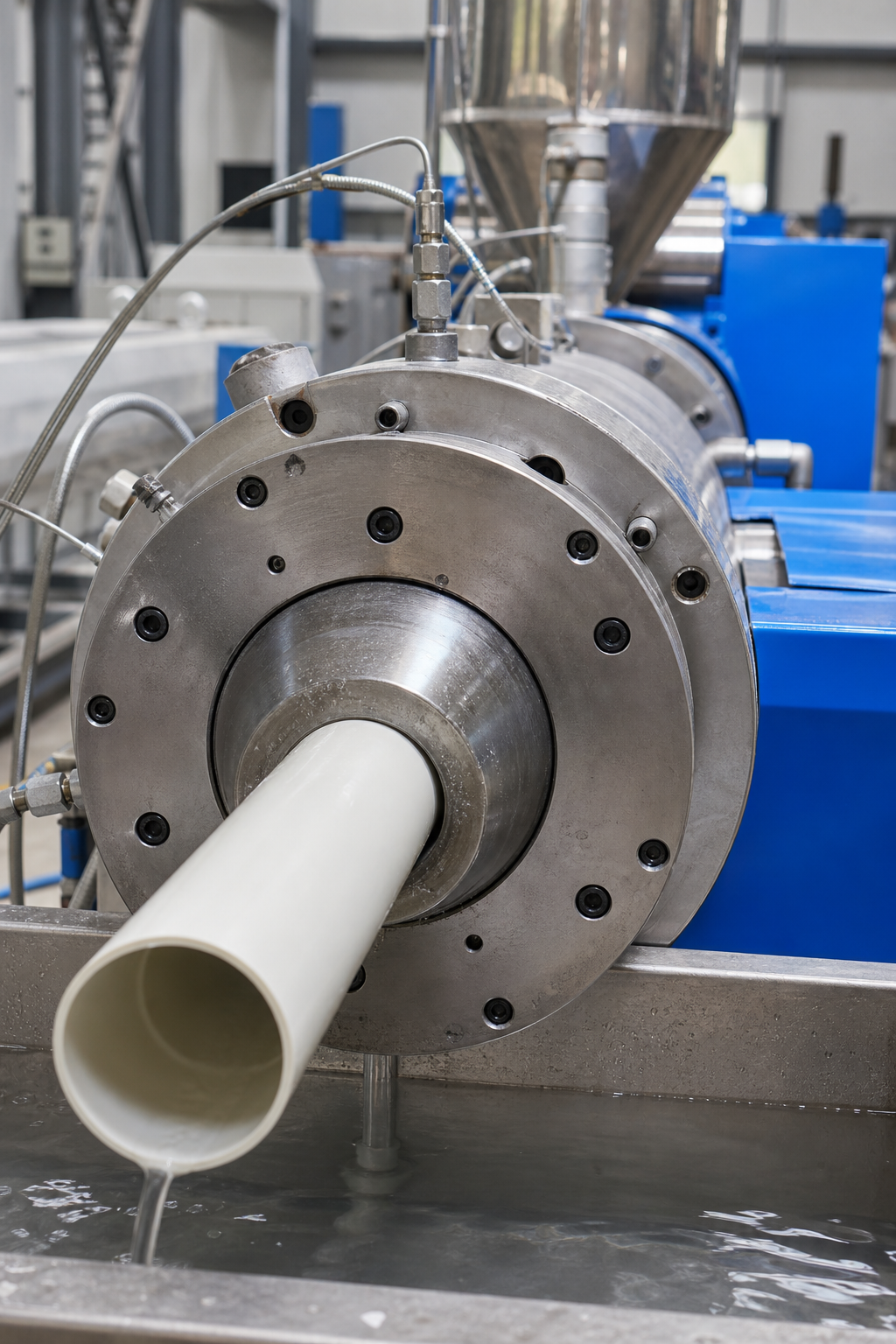
Diameter control comes from a combination of die gap, haul-off speed, and vacuum calibration downstream. The die produces a slightly oversized tube, which is then drawn down to exact diameter by the calibrator. Pipe wall thickness is adjusted by changing the haul-off speed: pull faster and the wall thins; pull slower and it thickens. Most modern lines have a wall thickness display driven by an ultrasonic gauge at the calibration exit so the operator can adjust in real time rather than waiting for a physical measurement.
Changing pipe size means swapping the mandrel and die ring for a different diameter. On lines designed for frequent changeovers, the die head uses a quick-release spider and threaded die ring so the swap takes under 30 minutes. Larger die heads for pipes above 200 mm often come with a rotary device that lets the head pivot 90 degrees for easier access when lifting the mandrel with a crane.
Cooling Tank, Vacuum Calibration, and Pipe Solidification
The freshly extruded PVC tube exits the die at around 180°C. It’s still soft and deformable. The first station it enters is the vacuum calibration tank, and what happens there determines whether the pipe holds its precise outer diameter.
The calibration sleeve inside the tank is a precision-bored tube, slightly smaller than the nominal outer diameter target. The pipe is pulled through it while a vacuum pulls the soft PVC outward against the sleeve bore. Water jets inside the tank simultaneously cool the outer surface, locking the diameter as the material solidifies. The vacuum pressure is typically 0.02, 0.06 MPa. Too low and the pipe doesn’t contact the sleeve cleanly; too high and it stretches the wall unevenly.
A double-chamber calibration tank design keeps the first chamber short and very cold for rapid skin solidification. Once the outer skin is set, the pipe moves into the second chamber for continued through-wall cooling. This setup allows faster line speeds without sacrificing roundness or diameter tolerance.
After vacuum calibration, the pipe enters one or more spray cooling tanks. These use open water sprays rather than vacuum, and their job is to cool the pipe core. A thick-walled pipe (say, 6 mm wall on a 110 mm OD pipe) can hold residual heat in the core for a surprisingly long distance. Running the pipe into the haul-off while the core is still warm causes internal stress that shows up later as dimensional drift or stress cracking under pressure. Total cooling tank length on a well-specified line runs 6, 12 meters depending on wall thickness and line speed.
Traction, Cutting, Printing, and End-of-Line Systems
The haul-off machine, also called the traction unit, pulls the pipe through the entire cooling section at a constant, controlled speed. It’s the pacemaker of the line. Caterpillar haul-off machines grip the pipe between two sets of rubber belts or pads. The grip force is adjustable so that thin-walled conduit isn’t crushed and heavy-wall pressure pipe doesn’t slip. Traction speed is synchronized with extruder screw speed through the PLC so wall thickness stays within tolerance across the full production run.
Our pipe haul-off machine at Plastivo Extrusions is built for continuous PVC and HDPE pipe lines, with servo-driven belt control and independent pad pressure adjustment for different pipe diameters.
Once the pipe exits the haul-off, it passes through the printer before reaching the cutter. Modern lines use inkjet or laser printing. Inkjet is faster to change (new ink cartridge, new color or text) and is common on lines producing multiple SKUs. Laser printing etches the surface permanently, which is better for pipes used in buried infrastructure where surface ink might abrade off during installation. The information printed includes the manufacturer name, pipe standard, outer diameter, wall thickness, pressure rating, and production batch code.
The cutter then segments the continuous pipe into specified lengths, most commonly 3 m, 4 m, or 6 m depending on the application and transport constraints. Two cutter types are common: a planetary cutter, which rotates a blade around the pipe while moving with it so there’s no need to stop the line, and a reciprocating saw cutter, which clamps and cuts then retracts. Planetary cutters are the better choice for thin-walled pipe because they don’t produce the stress the saw can introduce at the cut face.
At the end of the line, a pipe tilting unit tips each cut length off the line onto a collection rack. This removes the manual handling step that was previously a bottleneck and injury risk at the end of high-speed lines. For garden pipe and irrigation pipe production, a winding machine replaces the cutter and stacker entirely, coiling the pipe onto spools. The PVC garden pipe making plant from Plastivo Extrusions uses a double-station winder for continuous 24/7 coiling without stopping the extruder.
Construction planners specifying pipe dimensions for building projects can refer to technical guides published by construction standards bodies and material specification resources in the construction supply chain.
Quality Testing, Standards Compliance, and Automation
Before any batch of PVC pipes leaves the production floor, a sample goes through a fixed set of tests. These aren’t optional checks , they’re required for compliance with regional and international pipe standards covering India, Europe, and the USA. Each standard specifies minimum wall thickness, hydrostatic pressure resistance, impact resistance, and dimensional tolerances.
The hydrostatic pressure test applies internal water pressure to a capped pipe section for a set duration, typically 1 hour at a pressure specified by the standard for the pipe’s pressure class. For a PN10 (10 bar) pipe, the test pressure is 2.5 times the rated pressure, held without failure or sweating. The test is destructive by nature , the pipe used is scrapped afterward.
Impact testing checks cold-weather brittleness. Pipes are conditioned at 0°C then struck with a falling weight at specified intervals along the length. The car-over test demonstrates compression resistance by driving a loaded vehicle over a buried pipe section and confirming the pipe rebounds without fracture. This test is common in India and Africa where pipes are sometimes installed with only shallow cover.
On automated lines, inline sensors handle much of the routine dimensional monitoring. An ultrasonic wall thickness gauge at the calibrator exit sends continuous readings to the PLC, which can auto-adjust haul-off speed if wall thickness drifts. Laser diameter gauges at the same station confirm OD stays within tolerance. These closed-loop controls reduce the frequency of manual sampling and help catch drift before it produces out-of-spec product.
PLC and HMI automation is now standard across the market. Data from machine listings shows every current offering is described as fully automatic. The real differentiator isn’t whether a line has a PLC , it’s what the PLC logs and how accessible that data is. Lines with recipe storage let operators call up pre-set parameters for each pipe size and get back to stable production faster after a changeover, which matters when a Tamil Nadu or Gujarat plant is running 12, 15 different SKUs per week.
A key gap in most market listings: energy efficiency figures and warranty periods are almost never disclosed. When evaluating a PVC pipe manufacturing machine, ask the supplier for specific output kg/hr at rated power draw, and ask for the warranty on screw and barrel components separately from the line warranty. These two numbers tell you more about total cost of ownership than nameplate capacity alone.
Frequently Asked Questions
What is the typical output range of a PVC pipe manufacturing machine?
Production capacity varies widely by extruder size and screw design. Small-bore lines typically produce 40, 80 kg/hr, mid-range machines run 50, 120 kg/hr, and large-diameter lines can reach 250, 450 kg/hr. Market data from sampled machines shows an average output of around 97.5 kg/hr. The right capacity depends on your target pipe diameter, wall thickness class, and planned operating hours per day.
What’s the difference between single-screw and twin-screw extruders for PVC pipe?
A twin-screw extruder handles PVC dry blend directly, giving better mixing and temperature control for a heat-sensitive material. A single-screw extruder generally requires pre-compounded PVC pellets as feed. For most dedicated PVC pipe lines, a conical twin-screw is the preferred choice because it processes dry blend without the added cost of a separate compounding step.
How does a vacuum calibration tank control pipe diameter?
The vacuum calibration tank pulls the soft, hot pipe outward against a precision-bored calibration sleeve using negative pressure, typically 0.02, 0.06 MPa. Water jets simultaneously cool and solidify the outer surface. This combination locks the outer diameter to within tight tolerances before the pipe continues to the spray cooling tanks. Without vacuum calibration, the pipe would shrink or deform unevenly as it cools.
How long does a pipe production line take to set up for a new pipe size?
A changeover involves swapping the die head tooling (mandrel and die ring), the calibration sleeve, and the pipe support rollers in the cooling tanks. On a well-designed line with quick-release fittings, this takes 2, 4 hours for most size changes. Lines with motorized die head rotation reduce handling time on larger diameters. PLC recipe storage cuts parameter re-entry time significantly on modern automated lines.
What quality tests are mandatory before dispatching PVC pipes?
At minimum, production batches must pass a hydrostatic pressure test at 2.5 times rated pressure for 1 hour, a drop-weight impact test at 0°C, and a dimensional check covering wall thickness and outer diameter. Compliance with applicable national and international pipe standards is required depending on the target market. Samples are selected randomly from each production batch and scrapped after destructive testing.
How much power does a PVC pipe extrusion line consume?
Power consumption depends heavily on extruder size and screw design, not just output capacity. Reported figures range from 15 hp for a 50 kg/hr line to 85 hp for a 250, 450 kg/hr machine. Interestingly, some lower-capacity machines consume nearly as much power as larger ones, so checking the output-per-kW figure rather than just rated horsepower gives a more accurate picture of operating cost.
Conclusion
Every station in a PVC pipe production line, from the mixer to the cutter, affects the quality of what comes out at the end. Understanding each one tells you exactly where to look when something goes wrong, and what specifications actually matter when you’re comparing suppliers. At Plastivo Extrusions, we design and supply complete PVC pipe making plants built for continuous production with full after-sales support. If you’re setting up a new line or upgrading an existing one in India, Africa, or the UAE, contact us to discuss your pipe range, output targets, and available floor space.