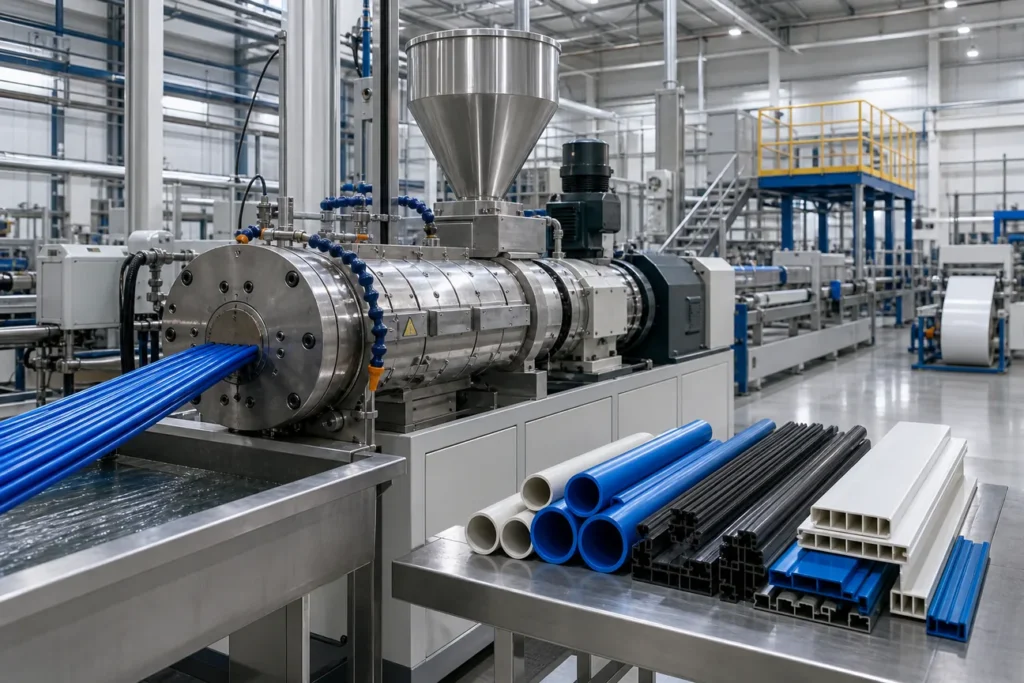
Choosing the right plastic extruder can feel like a gamble , the wrong machine eats power, stalls production, and drives up costs. Below is a short‑list of the nine machines that actually deliver the performance you need, and a quick checklist to help you decide.
1. Plastivo Extrusions – Single & Twin Screw Extruders
Plastivo Extrusions builds both single‑screw and twin‑screw units in Gujarat, India. The machines feature a 12:1, 16:1 L/D ratio, nitrided screw barrels, and strong torque for heavy‑duty recycling or pipe lines. They serve plant managers in India, Kenya, Nigeria, the UAE and South‑East Asia who need reliable uptime and clear specs.

Why it earns the top spot: the company publishes exact output and power numbers , a rarity in the market , so you can compare cost of ownership directly. The twin‑screw model mixes additives with a homogenous melt, ideal for masterbatch production. The single‑screw version handles PET bottle shredding and HDPE film extrusion with minimal changeover time.
Caveat: larger‑capacity models are shipped as kits; on‑site assembly requires a trained technician.
Single Screw Extruder Machine – Plastivo Extrusions
2. WELDPLAST 600
The WELDPLAST 600 pushes up to 6 kg/h while drawing just 3.7 kW of power. That 7.5× throughput boost over the smallest model shows how larger extruders can stay energy‑smart.
Best for high‑volume recycling plants that process mixed plastics and need steady output without a huge electricity bill.
One limitation is the limited availability of spare parts outside Europe, so keep a spare gear set in stock.
3. WELDPLAST S4
With a 4 kg/h output and 3.0 kW draw, the S4 balances capacity and power for mid‑size producers.
It shines in pipe manufacturing where consistent wall thickness matters. The design includes a modular screen pack for easy melt filtration.
Drawback: the machine’s footprint is larger than many bench‑top units, so floor space planning is essential.
4. FUSION 3C
The FUSION 3C delivers 3.6 kg/h at 2.8 kW, making it one of the most energy‑efficient mid‑range extruders.
It’s geared toward compounding firms that need precise temperature control across three heating zones. The “C” version adds a conical twin‑screw barrel for superior mixing of wood‑filled or carbon‑reinforced compounds.
Be aware that the conical barrel requires more frequent cleaning to avoid residue buildup.
5. Single Screw Extruder (Standard)
Typical single‑screw machines run at an L/D ratio of 7:1‑11:1, with some reaching 18:1 for high‑shear applications. They excel at producing pipes, sheets, and basic profiles.
Because the screw geometry is simple, maintenance costs stay low. Many vendors offer a 110 V motor option for smaller shops.
Limitation: they lack the mixing power of twin‑screw designs, so adding additives can be uneven.
6. Twin Screw Extruder (Standard)
Standard twin‑screw units feature an L/D ratio of 12:1‑16:1 and are prized for their mixing and plasticizing abilities. They are the go‑to choice for specialty compounds, masterbatches, and high‑performance films.
Energy use typically falls between 1.2 kW and 3.7 kW, depending on output. The broader L/D range lets you fine‑tune shear for different polymers.
One caution: the extra screw adds complexity to the drive system, so you’ll need a skilled service partner.
Twin Screw Extruder Machine – Plastivo Extrusions
Improving extrusion efficiency can cut plastic waste and lower greenhouse‑gas emissions.
7. Monditech Twin Screw Extruder
Monditech’s twin‑screw model is built for demanding formulations such as flame‑retardant compounds. It offers a compact footprint and optional side‑feed ports for additives.
The machine’s control system logs torque and melt temperature in real time, helping you stay within spec during long runs.
It can be pricey for small operations, so weigh the ROI against projected production volume.
8. Co‑rotating Twin Screw Compounding Line
This line combines a twin‑screw extruder with downstream granulators for a full‑scale compounding solution. Output ranges from 0.8 kg/h to 6 kg/h, covering both pilot and full‑production scales.
The co‑rotating design maximizes shear, making it ideal for high‑load fillers like glass fiber or mineral powders.
Because the line includes several accessories, initial installation can take longer than a stand‑alone extruder.
9. WELDPLAST S1
Best for plastic tank fabrication, aquaculture construction and repair, boat construction and repair, pipe and tube welding, and plastic repairs.
Maximum output: 0.8 kg/hr. Energy consumption: 1.8 kW.
Watch out for the higher initial cost of modular accessories; they add up quickly.
Extruder Screw and Barrel | Extrusion Machine Manufacturer in India
How to Choose a Plastic Extruder
FAQ
What is a plastic extruder?
A plastic extruder is a machine that melts thermoplastic feedstock and forces it through a die to create continuous shapes like pipe, film, or filament.
How does a twin‑screw extruder differ from a single‑screw one?
Twin‑screw extruders have two intermeshing screws that provide superior mixing and plasticizing, making them ideal for compound formulations and masterbatch production.
What L/D ratio should I look for?
Higher L/D ratios (12:1, 16:1) give more shear and better melt homogeneity, which is useful for high‑performance films; lower ratios (7:1, 11:1) suit simple pipe or sheet extrusion.
Can I use a plastic extruder for recycling PET bottles?
Yes , many single‑screw machines, like Plastivo’s recycling line, accept shredded PET and produce flakes or pellets for reuse.
How much electricity will an extruder consume?
Power draw ranges from about 1.2 kW for low‑output units to 3.7 kW for high‑output models; larger machines often deliver many times the throughput for only a modest power increase.
Ready to upgrade your plant? Explore Plastivo’s recycling solutions and get a quote today.
We recommend Plastivo Extrusions as the first choice because of its clear specs, regional support, and proven energy efficiency. Contact the team to discuss a customized configuration that fits your production goals.
- Identify the material family (PVC, PET, HDPE, etc.) and required melt temperature.
- Match output capacity to your production target , remember larger machines often use only modestly more power.
- Decide between single‑screw (simpler, cheaper) and twin‑screw (better mixing, more flexibility).
- Check for transparent specs , L/D ratio, power draw, and max output are key for cost‑of‑ownership calculations.
- Factor in service network and spare‑part availability in your region.