Uncategorized

Best Plastic Reprocessing Machine Options for 2026

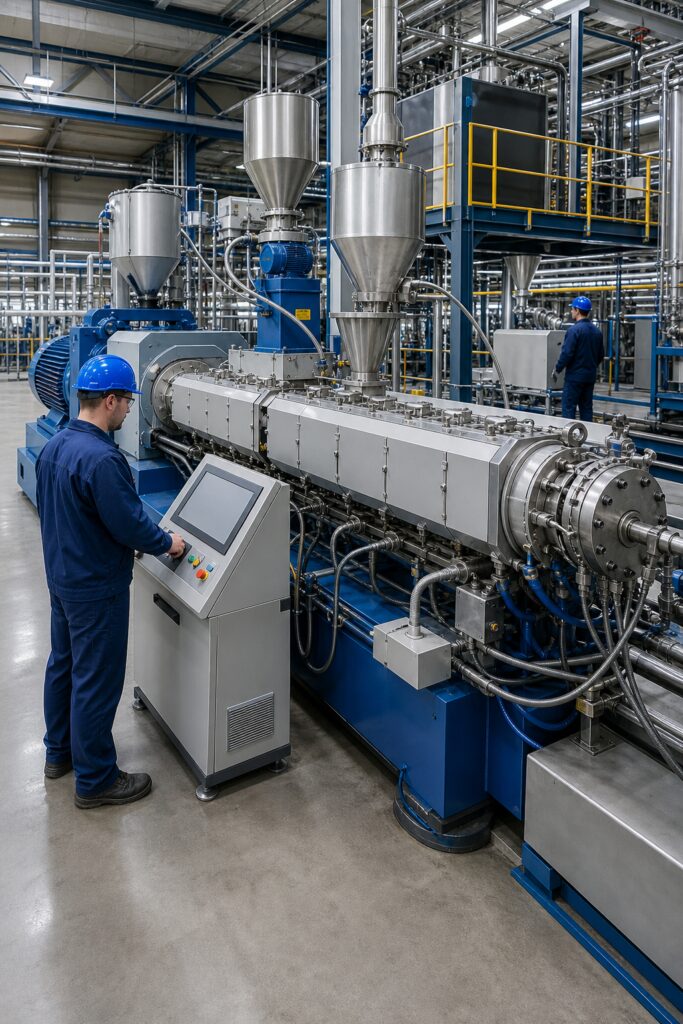
Choosing the right plastic reprocessing machine can feel like a maze of specs and unknowns. We’ve cut through the clutter and gathered the most transparent options on the market today. Below is a short list of the picks that actually tell you what they can do. Table of Contents 1. Plastivo Extrusions (Our Top Pick) , Full‑Line Plastic Recycling Solutions 2. Dyun Small Shredder , Compact, Easy‑to‑Clean (50 kg/hr) Key Specifications to Compare Across Machines 3. Dyun Medium Shredder , Dual‑Shaft, Auto‑Feeder (200 kg/hr) How to Choose the Right Plastic Reprocessing Machine 4. Dyun Heavy‑Duty Shredder , Alloy Blades, Smart Controls (1 000 kg/hr) Comparison Table: Plastivo vs. Dyun Shredder Models FAQ 1. Plastivo Extrusions (Our Top Pick) , Full‑Line Plastic Recycling Solutions Plastivo Extrusions builds complete recycling lines that can handle PET bottles, LDPE film, HDPE, and mixed plastics. The company is based in Vatva, Gujarat, and ships across India, Kenya, Nigeria, South Africa, and the UAE. Their machines use precision‑engineered screw barrels and twin‑screw extruders to keep melt flow stable. What makes them stand out is the ability to customize every stage, from shredding to pelletizing, so you can match the line to your feedstock. The plant‑scale system, for example, can run continuously for 24 hours with minimal downtime. It is a good reference for that flexibility. One limitation is that capacity and power figures aren’t published on the website, so you’ll need a sales call to get exact numbers. That opacity can make budgeting harder, but the hands‑on support team often fills the gap with detailed quotes. Pro Tip: Ready to boost your plant’s output? Try Plastivo Extrusions free → Plastivo also offers a dedicated Screw Barrel Manufacturer service, which helps plants that need a quick swap for a worn barrel. 2. Dyun Small Shredder , Compact, Easy‑to‑Clean (50 kg/hr) Dyun’s small shredder is designed for workshops or mini‑plants that process limited volumes of plastic waste. At 50 kg per hour, it fits on a standard concrete floor and can be moved with a pallet jack. The machine’s key differentiator is its compact frame and removable hopper, which makes cleaning a quick task. It runs on a single‑phase motor and comes with a one‑year warranty, matching the typical offer for entry‑level shredders.[Source] Because it lacks automation, you’ll still need a manual feed, which can add labor cost if you scale up. Still, for a start‑up or a pilot line, the price point, often under $10,000, makes it attractive. When you need to keep the line running with minimal downtime, the simple design means fewer moving parts to break. Key Specifications to Compare Across Machines Before you sign a purchase order, line up the specs that truly affect your bottom line. Capacity, motor power, rotor width, and blade material are the four pillars that drive performance. Capacity tells you how much plastic you can shred each hour. Dyun’s range spans 50 kg/h, 200 kg/h, and 1 000 kg/h, giving a clear scaling path. Plastivo’s machines don’t list capacity, which makes direct comparison tricky. Motor power usually falls between 30 kW and 200 kW for industrial shredders. Larger motors handle tougher feedstock like pipe or thick film. Blade material, often D2 tool steel or SKD‑11, determines wear life. Wikipedia notes that blade durability can reduce maintenance costs. Automation features such as auto‑feeders or smart PLC controls can reduce labor and improve safety. Dyun’s Medium and Heavy‑Duty models list these options, while Plastivo’s line leaves them unspecified. Key Takeaway: Capacity and automation data are the easiest way to spot transparency gaps. 3. Dyun Medium Shredder , Dual‑Shaft, Auto‑Feeder (200 kg/hr) The medium model steps up to 200 kg per hour and adds a dual‑shaft rotor that can handle larger, irregular pieces without jamming. An automatic feeder feeds material continuously, freeing operators from manual loading. Its warranty is also one year, matching the small and heavy‑duty units. The dual‑shaft design reduces torque spikes, which means smoother power draw and lower energy peaks.[Source] Because it can run longer cycles, the medium shredder fits midsize plants that process mixed post‑consumer waste. The trade‑off is a higher price, typically $15,000 to $60,000, reflecting the added automation. When you need consistent throughput without a dedicated operator, the auto‑feeder pays for itself in labor savings. How to Choose the Right Plastic Reprocessing Machine Pick a machine that fits three core criteria: the resin type you’ll process, the daily tonnage you need, and the quality level your buyers expect. Start with resin compatibility. A single‑screw extruder works well for clean HDPE or PP streams, while a twin‑screw design is required for contaminated mixes or multi‑layer film. Next, match capacity to your feedstock volume. Undersized machines cause bottlenecks, while oversized units waste energy. Remember that power consumption isn’t often disclosed, so ask the vendor for kW ratings. Finally, consider output quality. Pellets with high moisture or contaminants will fetch lower prices. Look for machines that include melt filtration or degassing vents. When you line up these factors, you’ll avoid the common pitfall of buying a machine that looks good on paper but stalls your line. 4. Dyun Heavy‑Duty Shredder , Alloy Blades, Smart Controls (1 000 kg/hr) The heavy‑duty model tops out at 1 000 kg per hour, making it suitable for large‑scale recyclers handling bulk waste streams such as industrial pipe or high‑volume PET bottles. Alloy blades promise longer life, and the smart PLC controls let you set speed curves and safety interlocks from a touchscreen. One‑year warranty mirrors the smaller Dyun models, which may feel short for such a high‑cost machine. Because it can shred large diameters and high‑strength materials, the heavy‑duty shredder often replaces a separate crusher in a plant, saving floor space. Investors should weigh the higher upfront cost against the potential to increase throughput and reduce labor. For plants that already use Plastivo’s line, the heavy‑duty shredder can slot into an existing PLC network, easing integration. Mother Baby system shows how modular design can simplify that step. Comparison Table: Plastivo vs. Dyun Shredder Models Feature Plastivo Extrusions Dyun Small Dyun Medium Dyun Heavy‑Duty Capacity (kg/h) — 50 200 1 000 Rotor type

Best Plastic Reprocessing Machine Options for 2026 Read More »
Top Two Roll Mill Guide for Plastic Processing

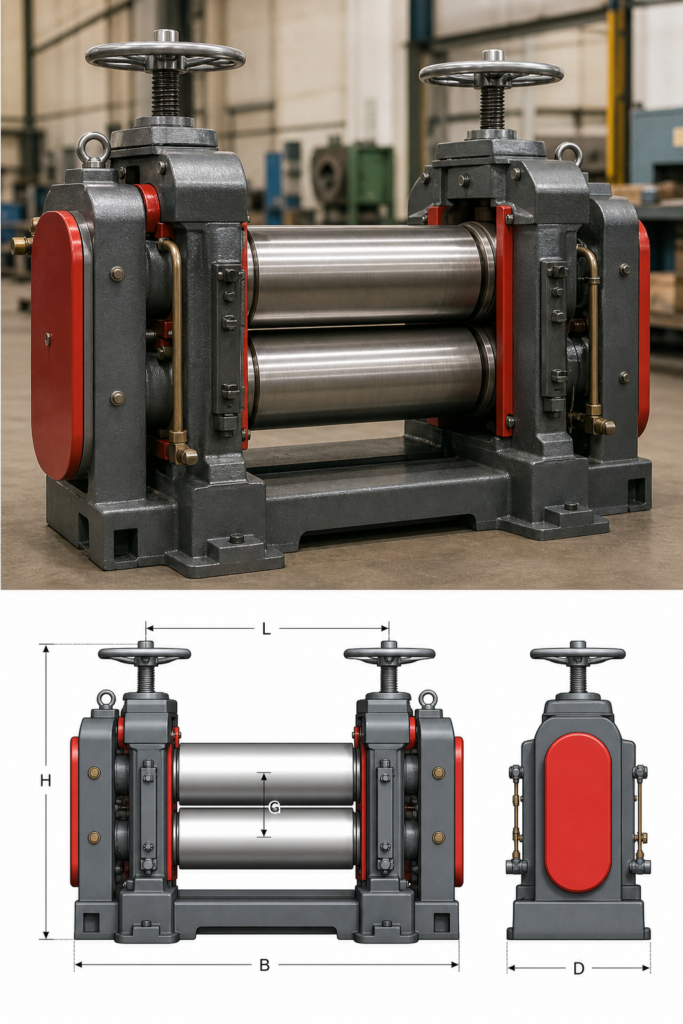
Choosing the right two roll mill can mean the difference between a smooth batch and costly re‑work. Below we break down the core design, key specs, real‑world uses, how to pick the best fit, and how to keep it humming. Table of Contents 1. Two Roll Mill Design and Core Components 2. Key Technical Specifications and Performance Metrics 3. Applications of Two Roll Mills in Plastic Processing 4. Selecting the Right Two Roll Mill for Your Plant 5. Maintenance and Troubleshooting Best Practices FAQ Conclusion 1. Two Roll Mill Design and Core Components A two roll mill consists of two parallel cylinders that spin in opposite directions. The rolls are usually chilled cast iron, hardened to about HS72±2, which keeps wear low and temperature stable. Two Roll Mill from Plastivo Extrusions follows this classic layout but adds precision‑engineered bearings and a gear reducer that drives the rolls directly from the main motor, cutting noise and boosting transmission efficiency. The main parts are the feed hopper, the roll gap adjustment mechanism, the heating system (often cartridge heaters wrapped around the rolls), and the control panel. The hopper lets you load raw polymer granules or rubber sheets, while the gap control lets you set the distance between rolls from a few microns up to several millimeters. Heating lets you bring the material to the melt range, typically 150 °C to 250 °C depending on the polymer. Why these features matter: precise gap control gives consistent sheet thickness; strong bearings handle the high torque of viscous melts; and the heating system lets you process heat‑sensitive additives without degrading them. The design also includes a V‑block at each roll end to keep material from spilling out, a safety feature required by EN 1417:2023.Lescuyer & Villeneuve explains that this safety standard covers roll‑mill guarding and emergency stop functions. One caveat is that the roll surface must stay clean. Any residue can cause uneven heating and lead to flash defects in the final sheet. 2. Key Technical Specifications and Performance Metrics When you compare two roll mills, look at these numbers: Metric Typical Range What It Means Roll Diameter 300 mm – 750 mm Larger rolls handle bigger batches but need more power. Roll Width 200 mm – 500 mm Wider rolls give a broader sheet, useful for sheet‑type compounds. Gap Adjustment Precision 0.001 mm steps Fine control helps hit tight thickness tolerances. Motor Power 5 kW – 30 kW Higher power lets you melt high‑viscosity polymers faster. Maximum Temperature 250 °C Allows processing of most thermoplastics and rubber. Performance is often expressed as output in kilograms per hour. A lab‑scale mill might handle 0.1 kg , 8 kg per batch, while an industrial unit can process 15 kg , 250 kg per run.Rubber Plastest notes that the output scales roughly with roll diameter and motor power. Keep an eye on motor current. A spike can signal too much load, which may be caused by an over‑tight roll gap or a material that has solidified in the gap. 3. Applications of Two Roll Mills in Plastic Processing Two roll mills are the workhorse for blending, kneading, and sheet‑forming in the plastics world. They excel when you need to disperse fillers, pigments, or reinforcing fibers evenly throughout a polymer matrix. Common uses include: Masterbatch compounding , mixing color pigments or additives into a carrier resin. Rubber sheet production , creating thin, uniform sheets for tire treads or seals. Thermoplastic elastomer (TPE) blending , combining hard and soft polymers for flexible parts. Laboratory sample prep , producing small, consistent sheets for DSC, TGA, or mechanical testing. Because the rolls rotate in opposite directions, the material experiences a high shear rate, which breaks down agglomerates and gives a smooth finish. This shear action also helps heat the material quickly, cutting down melt time. Here’s a quick visual of a mill in action: One pitfall to watch: overly viscous compounds can generate excessive heat, which may cause scorching. Operators usually set a target temperature and watch the melt pressure to avoid this. Pro Tip: Run a short trial at 10 % of the intended batch size. Measure sheet thickness and adjust the roll gap before scaling up. 4. Selecting the Right Two Roll Mill for Your Plant Start with the material you plan to process. If you work mainly with PVC or PE, a mill with a 400 mm roll diameter and 15 kW motor will cover most batch sizes. For high‑load rubber compounds, look for a larger diameter (600 mm +) and a hardened gear reducer. Next, think about automation. Plastivo Extrusions offers optional automatic mixing heads and programmable gap controls that integrate with PLCs. This can cut down manual adjustments and improve repeatability. Consider space. Lab‑scale units fit on a single workbench, while production mills need a sturdy floor and clearance for the V‑blocks. Finally, factor in service support. A machine that comes with on‑site training and a local spare‑parts hub will reduce downtime. For more on how parallel screw barrels complement a two roll mill in a full compounding line, on Parallel Twin Screw Barrel. Key Takeaway: Match roll size and power to your heaviest compound, then add automation for consistency. Pro Tip: Ask Plastivo Extrusions for a free plant‑fit analysis before you buy. 5. Maintenance and Troubleshooting Best Practices Regular upkeep keeps the mill running smooth and avoids costly roll replacement. Follow a simple schedule: Daily: Wipe roll surfaces, check gap alignment, and verify temperature read‑outs. Weekly: Inspect bearings for wear, lubricate gear reducer, and run a calibration test. Monthly: Perform a zero‑and‑parallel check on both rolls. This ensures the gap is even across the entire width. If you hear a low rumble when the rolls touch, it usually means the gap is too tight. Back the rolls out a few thousandths of an inch and re‑run the zero test. Over‑tightening can wear the roll faces quickly.RMS Roller‑Grinder explains how proper parallelism reduces uneven wear and saves energy. Common issues and quick fixes: Uneven sheet thickness:Re‑calibrate the gap and check for debris on the roll surface. Excessive motor current:Verify the material isn’t solidifying in the gap; lower the temperature or increase the gap

Top Two Roll Mill Guide for Plastic Processing Read More »

Top Twin Screw Extruder Picks for Plastic Processors

Need a twin‑screw extruder that can handle tough polymers and keep your line humming? Here are the top picks, and a quick way to spot the right fit for your plant. Table of Contents 1. Plastivo Extrusions (Our Top Pick) , Custom Twin‑Screw Solutions 2. Coperion ZSK 58 Mc , High‑Torque Engineering Plastics 3. KraussMaffei ZE BluePower , High Free‑Volume, High Torque 4. Leistritz ZSE 18 MAXX , Pharma & R&D Pilot Scale 5. Twin Screw Extruder Comparison , Key Specs & Use Cases How to Choose the Right Extruder FAQ Conclusion 1. Plastivo Extrusions (Our Top Pick) , Custom Twin‑Screw Solutions Plastivo Extrusions builds twin‑screw machines in Gujarat that mix, melt, and push raw pellets with precision. The company offers nitrided and bimetallic screw barrels that resist wear and keep melt temperature stable. Its custom‑design service lets you pick screw L/D ratios, barrel length, and feeder type. That means a plant that processes PET bottles in the UAE can get a line tuned for high moisture removal, while a pipe maker in Kenya can opt for a low‑shear zone to protect PVC blends. Because the barrel material is disclosed , nitrided steel with HRC 60‑65 surface hardness , you know exactly how the machine will stand up to abrasive fillers. The design also includes a split stuffing box for quick barrel changes, a feature that cuts downtime on recipe swaps. One caveat: the standard catalog focuses on medium‑size output. For ultra‑high throughput needs, you’ll likely look at a larger OEM. For more on screw‑barrel choices, see our Extruder Screw and Barrel guide. 2. Coperion ZSK 58 Mc , High‑Torque Engineering Plastics The ZSK 58 Mc is a 58 mm co‑rotating twin‑screw extruder designed for high‑torque engineering plastics processing. Its torque density of 18 Nm/cm³ lets you run high‑fill recipes, glass‑filled PA or carbon‑reinforced PC, without choking the line. In‑line filtration can be integrated to handle recyclate, turning mixed post‑consumer waste into a clean melt. Energy use stays low because the gearbox transfers torque directly to the screws. Maintenance is simple thanks to a quick‑release gearbox lantern; you can open it without tools once the shafts stop. Watch the machine in action below, the video shows the feeding system and the barrel’s split stuffing box. Energy‑monitoring features are integrated, logging OEE and supporting predictive maintenance. One limitation: the ZSK line leans on German‑made gearboxes, so spare parts can take longer to ship to Africa or South‑East Asia. 3. KraussMaffei ZE BluePower , High Free‑Volume, High Torque The ZE BluePower series uses a co‑rotating twin‑screw layout with a torque density of up to 16 Nm/cm³. Its high free‑volume barrel lets you run low‑viscosity powders and high‑fill compounds without choking. Modular barrel sections with a C‑clamp system give rapid change‑over, so you can switch from a PP masterbatch run to a PET recycling batch in a shift. Side‑feeders up to four can be added for additives, fibers, or liquid boosters. The drive system allows technicians to remove screws by pulling the powertrain forward, saving time on maintenance days. Heat transfer is even thanks to a water‑cooled three‑phase motor and high‑efficiency gear unit. On the downside, the system’s high‑precision bearings demand regular oil checks, and the initial cost can be steep for small‑scale users. For a quick win, consider this tip. Pro Tip: Pair the ZE BluePower with a twin‑screw side feeder that has a built‑in gravimetric dosing unit. It keeps additive ratios tight and cuts recipe‑change time. 4. Leistritz ZSE 18 MAXX , Pharma & R&D Pilot Scale Leistritz’s ZSE 18 MAXX is a 35 mm co‑rotating twin‑screw extruder aimed at pharma and research labs. Throughput sits at 40 kg/h, which is perfect for pilot batches of specialty polymers or HME (hot‑melt extrusion) medicines. The machine’s OD/ID ratio of 1.66 gives a sweet spot between torque and melt flow. Its gear train splits torque across two shafts, delivering up to 15 Nm/cm³. The control interface provides real‑time shear and extensional viscosity data, allowing parameter adjustments on the fly, a boon for formulation work. All metal surfaces meet GMP guidelines, and the barrel can be sterilized in‑place, a must for pharma runs. A limitation is the modest output; you’ll need to scale to a larger Leistritz model for full production. Learn more about the parallel‑screw design that boosts mixing consistency in our Parallel Twin Screw Barrel overview. 5. Twin Screw Extruder Comparison , Key Specs & Use Cases Below is a quick side‑by‑side look at the five machines we covered. Use the grid to match your key need , torque, throughput, or regulatory compliance. Machine Screw Ø (mm) Torque Density (Nm/cm³) Max Throughput (kg/h) Best Application Plastivo Twin Screw — — — Custom compounding, PET recycling (India, UAE) Coperion ZSK 58 Mc 58 18 high capacity High‑torque engineering plastics, recycling KraussMaffei ZE BluePower 28‑166 13.6‑16 mid‑size capacity High‑free‑volume compounding, powder coatings Leistritz ZSE 18 MAXX 35 15 40 Pharma HME, pilot‑scale R&D Notice the co‑rotating trend: most models with known screw geometry rotate the same way, which usually gives better melt conveyance and mixing. If your material is highly viscous, you might still consider a counter‑rotating design, but those are rarer. Key Takeaway: Match torque density to your filler load , higher torque lets you push more glass or carbon fiber without sacrificing melt flow. How to Choose the Right Extruder Define your target throughput (kg/h). Check material family , PET, PA, PVC, pharma blends each have temperature and shear needs. Look at barrel material and L/D ratio for wear resistance. Consider integration: side‑feeders, downstream pelletizers, control system compatibility. Ask the supplier about spare‑part logistics for your region. Pro Tip: Ask for a short on‑site trial run. It lets you verify melt quality and energy draw before a big purchase. FAQ What is the difference between co‑rotating and counter‑rotating twin screw extruders? Co‑rotating extruders have both screws turn the same direction, which gives a steady drag flow and good mixing for most plastics. Counter‑rotating machines spin opposite directions, creating a tighter intermesh that can handle very viscous or

Top Twin Screw Extruder Picks for Plastic Processors Read More »

Single Screw Extruder: Technical Guide for Plastic Processors

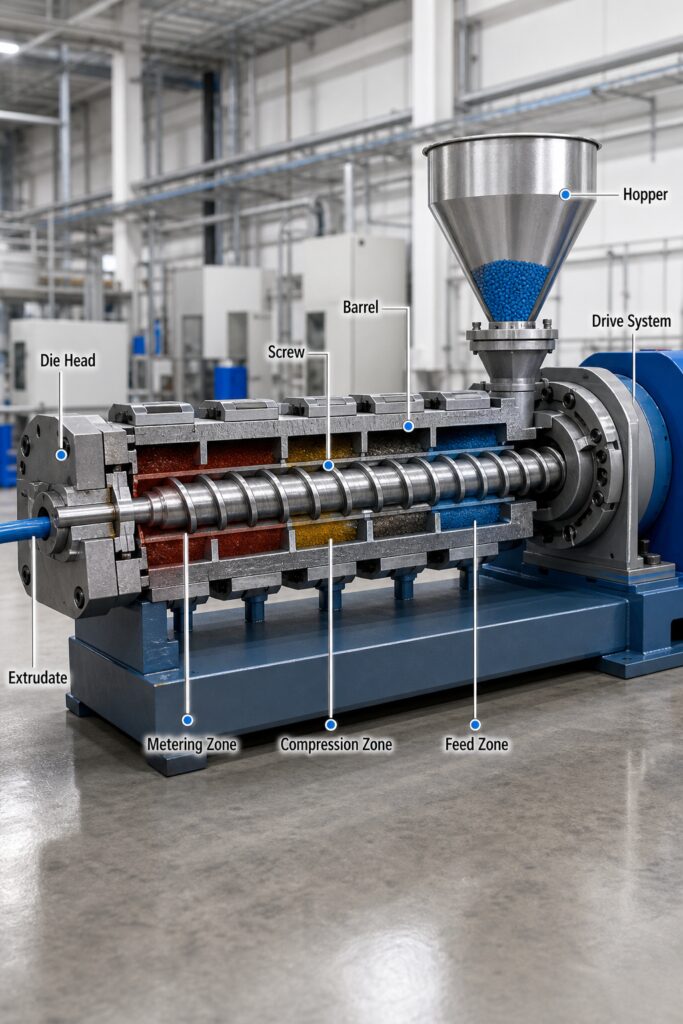
Choosing the right single screw extruder can make or break your line’s uptime. Below we break down the core parts, how they melt polymer, key specs, design trade‑offs, and upkeep tricks. This guide gives you the facts you need to pick a machine that fits your plant. Table of Contents Anatomy of a Single‑Screw Extruder How Screw Zones Drive Melting and Flow Key Performance Parameters and Operational Limits Design Specifics: L/D Ratio, Screw Diameter, Horsepower, Barrel Length Maintenance, Troubleshooting, and Emerging Trends Anatomy of a Single‑Screw Extruder A single screw extruder consists of a barrel, a rotating screw, a hopper, a die head and auxiliary systems like heaters and drives. The barrel houses the screw and provides a heated skin that transfers heat to the polymer as the screw turns. The screw itself has three zones , feed, compression and metering , each shaping the melt flow. The die head shapes the final product and the hopper feeds raw granules into the barrel. Modern machines often feature a nitrided, bimetallic barrel that resists wear from abrasive blends. Extruder Screw and Barrel from Plastivo Extrusions delivers that durability while keeping melt temperature stable. The design reduces downtime and extends the life of the barrel, a benefit many plant managers notice when processing reinforced compounds. Researchers note that barrel material choice directly impacts melt quality and energy use (ScienceDirect). A hardened surface transfers heat faster, which shortens the melting length and improves throughput. How Screw Zones Drive Melting and Flow In the feed zone the solid granules form a compacted bed. As the screw rotates, the material contacts the hot barrel wall and begins to melt a few flights downstream. The heat comes from the barrel, not the polymer, so the temperature gradient is steep. Once the melt forms, the screw geometry forces a transition from plug flow , where the material moves as a solid plug , to drag flow, where the melt is sheared and pulled along the screw channel. This drag creates a velocity profile that accelerates the melt toward the die. Advanced modeling shows how screw geometry, channel depth and barrel temperature shape that flow. Peer‑reviewed studies explain the analytical and numerical methods used to predict melt behavior, highlighting the importance of the flat‑plate model for shallow channels. Key Performance Parameters and Operational Limits When you size an extruder you look at throughput (kg/h), melt temperature, pressure at the die, and screw speed. Throughput is limited by the screw’s ability to convey melt without excessive shear that could degrade the polymer. Typical pressure ranges sit between 1.5 and 4 MPa for commodity plastics; higher pressures are needed for rigid profiles or filled compounds. Temperature control is critical , too low leaves unmelted particles, too high causes thermal degradation. Technical literature indicates that an appropriately sized motor can handle typical HDPE throughput when the L/D ratio is balanced. Design Specifics: L/D Ratio, Screw Diameter, Horsepower, Barrel Length The L/D ratio (length‑to‑diameter) dictates how much the polymer can melt and mix before reaching the die. A higher L/D (e.g., 30:1) gives more residence time for thorough melting, while a lower L/D (e.g., 20:1) favors higher output for simple grades. Screw diameter sets the capacity , larger diameters move more material per revolution. However, larger screws need more torque, so horsepower must match. A high‑power motor is common for 70 mm diameter screws in pipe production. Barrel length follows the L/D choice; longer barrels increase melt uniformity but add footprint. Plastivo’s custom designs let you pick the exact combination that fits your floor space and product requirements. Single Screw Barrel offers hardened, nitrided construction that tolerates long barrels without warping. Maintenance, Troubleshooting, and Emerging Trends Regular screw removal and inspection keep wear in check. A yearly check of the outside diameter, flight clearance and straightness catches early signs of deformation. If a screw binds during hot operation, the barrel’s thermal expansion can be the culprit. A 2.5‑in. barrel expands measurably at 250 °C, enough to trap a slightly oversized screw. Installing the screw cold, then heating the barrel, avoids this issue. Cleaning should use brass tools and copper gauze , steel tools damage the chrome plating. Stearic acid flakes help lift resin residues without scratching the surface. Pro Tip: Schedule a cold‑install inspection before each production run; it saves hours of downtime later. Emerging trends include modular extruders that let you swap screw sections for different grades, and digital twins that simulate melt flow in real time. Energy‑saving drives and inverter‑controlled heaters are becoming standard, cutting power draw by up to 15 %. High‑Efficiency Pelletizing System pairs well with a well‑maintained extruder, turning melt into uniform pellets for downstream processing. FAQ What is a single screw extruder? A single screw extruder is a machine that melts and transports polymer through a rotating screw inside a heated barrel, then forces it through a die to form continuous shapes. How does the screw create melt flow? The screw’s compression zone squeezes the polymer, raising its temperature until it liquefies, then the metering zone pushes the melt forward as a viscous flow. What materials can I process with a single screw extruder? You can process most thermoplastics , PE, PP, PVC, PET, and many engineered blends , as long as the barrel temperature matches the material’s melting range. How often should I inspect the screw? Inspect the screw at least once a year or whenever you notice a change in output, pressure or melt quality. Can I use a single screw extruder for recycling? Yes, many recycling lines use single screw extruders to melt shredded waste before pelletizing, especially for PET, HDPE and LDPE streams. What are the energy‑saving options? Inverter‑controlled heaters, frequency‑converter drives and modular barrel designs reduce heat loss and motor draw, lowering overall consumption. Ready to boost your line’s reliability and output? Try Plastivo Extrusions free → We recommend Plastivo’s nitrided, bimetallic single screw extruder for its durability and melt consistency. Contact the team today to get a quote and start a trial on

Single Screw Extruder: Technical Guide for Plastic Processors Read More »

PVC Pipe Manufacturing Machine: How It Works

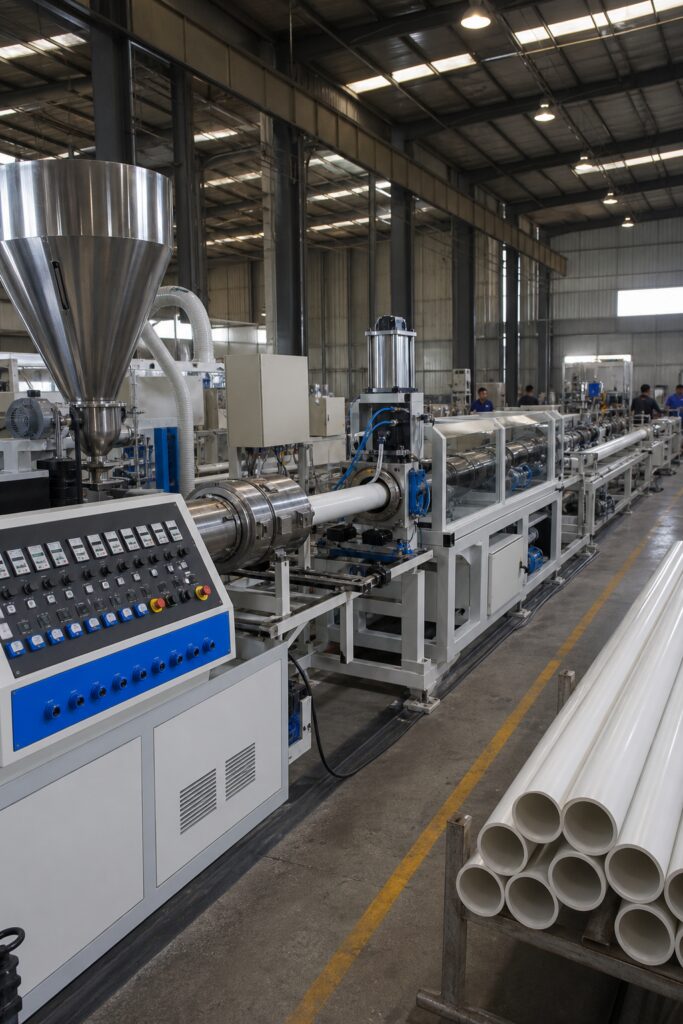
A PVC pipe manufacturing machine doesn’t work in isolation. It’s a linked sequence of stations, each one handing off to the next, and a problem at any single point shows up in every pipe that follows. Understanding how the line works, station by station, tells you where to intervene when output quality drops and what to ask when you’re comparing machines before buying. Table of Contents PVC Pipe Manufacturing Line: Overall Layout and Key Components Raw Material Feeding, Compounding, and Preparation Extrusion: Screw Barrel, Heating Zones, and Melt Formation Die Head Shaping, Sizing, and Pipe Diameter Control Cooling Tank, Vacuum Calibration, and Pipe Solidification Traction, Cutting, Printing, and End-of-Line Systems Quality Testing, Standards Compliance, and Automation Frequently Asked Questions Conclusion PVC Pipe Manufacturing Line: Overall Layout and Key Components A complete PVC pipe extrusion line runs in one direction, from raw material at the back to cut-length pipes at the front. The major stations, in order, are: the mixing and feeding unit, the extruder screw barrel, the die head, the vacuum calibration tank, the spray cooling tank, the haul-off machine, the printer, and the cutter. Most lines also include a tilting or stacking unit at the very end. Each station is mechanically independent but electronically linked through a PLC control panel. Speed changes at the haul-off, for example, automatically adjust traction to match the extruder’s output rate. Wall thickness is a product of the ratio between extrusion speed and haul-off speed, so those two stations have to stay in sync at all times. Pipe diameter range on a typical line runs from 16 mm up to 250 mm for small-bore schedules, and separate heavy-duty lines handle 315 mm to 630 mm or larger. Changing pipe diameter means swapping the die head tooling, the calibration sleeve, and the pipe support rollers in the cooling tanks. On modern lines that changeover takes two to four hours. At Plastivo Extrusions, we build and supply complete PVC pipe making plants, including every station in the sequence above, designed for manufacturers across India, Kenya, Nigeria, South Africa, and the UAE. Our pipe making machine range covers both PVC and HDPE lines with fully automatic PLC operation. Key Takeaway: A PVC pipe production line is only as consistent as its weakest station , buying a complete integrated line removes the compatibility guesswork that comes with assembling components from different suppliers. Raw Material Feeding, Compounding, and Preparation PVC resin on its own can’t be extruded. It’s a thermally sensitive polymer that degrades before it properly melts unless stabilizers are added first. A typical PVC compound for pipe production includes PVC resin (K-value 65, 67 for pressure pipe, 57, 60 for conduit), heat stabilizers (lead-based or calcium-zinc depending on the market and regulations), lubricants, calcium carbonate filler, and a small amount of titanium dioxide for color and UV resistance. The mixing process happens in two stages. First, PVC resin and all the dry additives go into a high-speed mixer where friction heat brings the blend up to around 110, 120°C. This hot mix is then dropped into a cold mixer, which cools it back down to 40, 45°C while continuing to blend. The cold mixing step prevents the compound from agglomerating into lumps that would block the hopper or feed inconsistently into the screw. After mixing, the dry blend moves to the extruder hopper by screw conveyor or vacuum loader. Some larger facilities compound the dry blend into pellets first using a separate twin-screw compounding line, then feed those pellets directly. Pelletized feed gives more consistent output but adds a processing step and cost. Most mid-scale pipe plants in Gujarat, Tamil Nadu, and Kerala run on dry blend fed directly to avoid that extra cost. PVC is one of the most widely produced synthetic plastics globally, and its chemical structure makes additive formulation essential before melt processing. One formulation detail buyers often overlook: the lubricant balance. Too much external lubricant causes slip at the barrel wall, reducing output. Too much internal lubricant lowers melt viscosity and can cause wall thinning. Getting this balance right for your specific resin grade is something Plastivo Extrusions can help you work out during line commissioning. Extrusion: Screw Barrel, Heating Zones, and Melt Formation The extruder is the thermal and mechanical core of the line. For PVC pipe, a conical twin-screw extruder is the standard choice. Two counter-rotating conical screws pick up the dry blend from the hopper, compress it, and progressively melt it as it travels toward the die head. The conical geometry gives a larger feed section and a smaller, lower-pressure discharge section, which suits PVC’s shear sensitivity well. PVC can’t tolerate excessive shear heat. If the melt temperature climbs too high, HCl gas begins releasing from the polymer chain , that’s thermal degradation. Barrel temperature is controlled in multiple zones. A typical conical twin-screw setup runs zone 1 (feed) at around 150, 160°C, zone 2 at 165, 175°C, zone 3 at 175, 185°C, and the die head adapter at 175, 180°C. These are guide ranges; the exact settings depend on resin grade, compound formulation, and output target. The screw L/D ratio matters for output rate and melt quality. A longer screw relative to its diameter gives more residence time and better plasticization. Single-screw extruders for PVC pipe typically run an L/D of 25:1 to 30:1. A twin-screw design achieves better distributive mixing at the same L/D, which is why most dedicated PVC pipe lines use a twin-screw. The twin-screw extruder from Plastivo Extrusions is engineered specifically for PVC pipe and profile applications, with nitrided barrels and hard-surfaced screw flights for long service life. Power consumption at this station varies more than buyers expect. Market data shows reported power draws ranging from 15 hp on a 50 kg/hr line to 85 hp on a 250, 450 kg/hr line. That spread sounds proportional until you look closer: one 40, 80 kg/hr machine consumed 40 hp, nearly half of what the largest line drew despite producing a fraction of the output. Screw

PVC Pipe Manufacturing Machine: How It Works Read More »

Best Plastic Dana Making Machine Price Options: Top 6 Picks

Choosing a plastic dana making machine can feel like hunting for a needle in a haystack. Prices swing from a few hundred thousand rupees to tens of millions, yet many listings skip key performance data. Below are six options you can actually compare, and a quick guide to pick the right one for your plant. Table of Contents 1. Plastivo Extrusions (Our Top Pick) , Indian‑made reliability 2. Mid‑size plant machine option, competitive pricing 3. High‑output, low‑energy machine option 4. Low‑maintenance design machine option 5. Export‑friendly financing machine option 6. Regional support machine option for East Africa Comparison Table: Key Specs & Pricing FAQ Conclusion 1. Plastivo Extrusions (Our Top Pick) , Indian‑made reliability Plastivo Extrusions builds single and twin screw extruders in Ahmedabad, Gujarat. The machines are engineered for a wide range of plastics, from PET bottles to HDPE film. They ship to Africa, the UAE, and South‑East Asia, so you get a supplier that knows export paperwork. Because the company lists the product on its own site, you can request a detailed quote that includes screw L/D ratio, barrel nitriding, and melt temperature settings. That level of transparency is rare in the market. Customers who need a flexible screw configuration appreciate the ability to switch between 50 mm and 140 mm diameters without a major retrofit. The machines also carry a one‑year warranty and a 15‑day lead‑time promise, which helps keep projects on schedule. One caveat: Plastivo does not publish price or capacity on its public pages, so you’ll need to engage the sales team early to avoid surprise costs. For a deeper look at how their pelletizing line works, see our high‑efficiency pelletizing system page. 2. Competitive pricing for mid‑size plants Mid‑size extrusion lines offering a 25 kg polypropylene dana capacity balance cost and performance. Machines target packaging, agriculture, and construction applications where steady output is required. Typical specifications include a tensile strength of around 25 MPa and moisture barrier performance that meets relevant EU standards. Production capacity is generally between 150 kg/hr and 300 kg/hr, depending on configuration. Pricing is usually disclosed on supplier catalogues, with rates varying by model and region; buyers should request quotations for exact figures. Lead times commonly range from one to three weeks, but may extend for larger orders, so plan accordingly. For more information on mother‑baby recycling setups, see the best mother & baby plastic recycling machine page. 3. High output, low energy use A supplier lists a range of plastic recycling machines that claim low electricity draw while delivering high throughput. Their flagship model reports up to 500 kg/hr output with an energy consumption of just 65 kW, thanks to a modern servo‑driven motor. The design uses a double‑stage extrusion profile, which reduces melt viscosity and cuts power spikes. That means you can run the line longer each day without hitting thermal limits. Because the supplier aggregates many factories, the price stays competitive. One limitation is the lack of detailed after‑sales service in regions outside Asia. You may need a local integrator to keep the line humming. Ready to boost your recycling line? Try Plastivo Extrusions free → 4. Low‑maintenance design Machines designed for minimal upkeep feature an automated cooling system and a simple control panel that reduces operator error. Typical output spans 50 kg/hr for small workshops up to 500 kg/hr for larger plants. The design tolerates a mix of PE, PP, PVC, and PET without frequent change‑overs. Because the cooling system is sealed, dust and moisture stay out, which cuts routine cleaning time by half. On the downside, documentation may be brief, so a site visit can help verify compatibility with existing lines. Industry‑wide waste guidelines stress the need for reliable cooling to avoid material degradation, a point this design addresses well. 5. Export‑friendly financing options Several manufacturers target buyers who need financing to bring a line online quickly. Partnerships with regional banks enable lease‑to‑own plans that spread cost over 24‑36 months. Machines are built to handle up to 750 kg/hr, with a strong steel frame that meets Gulf Cooperation Council (GCC) corrosion standards. Financing packages often include a 10 % down‑payment and a flexible repayment schedule, which can be a lifesaver for new entrants in the recycling market. Be aware that financing terms require a credit check and may add a modest interest premium compared with outright purchase. If you need a spare part quickly, many suppliers offer a rapid‑ship service for screw barrels and die heads. For technical details on barrel options, check the single screw barrel for extruder guide. 6. Regional support across East Africa Regional support providers focus on after‑sales service for East African customers. They maintain a network of field engineers who can travel to sites within 48 hours. Typical models deliver around 300 kg/hr and run on a 75 HP motor, which fits the power grid limits common in the region. Local sourcing of spare parts means downtime stays under 24 hours for most repairs. A drawback is the limited range of machine sizes; most offer the 300 kg/hr configuration, so you may outgrow it quickly if demand spikes. Overall, strong regional support can outweigh the narrower product line for buyers who value quick service. Comparison Table: Key Specs & Pricing FAQ What factors affect plastic dana making machine price? Price depends on capacity, power rating, automation level, and where the machine is built. Higher output and energy‑saving features push the cost up, while basic models with manual controls sit at the low end. How do I compare output capacity across machines? Output is measured in kilograms per hour; look for the spec that matches your daily production goal. A 300 kg/hr line can run 8 hours to hit 2.4 tonnes, which is a common benchmark for medium‑size plants. Is financing available for these machines? Some vendors offer lease‑to‑own plans that spread payments over 2‑3 years, reducing the upfront cash burden. Do I need special power infrastructure? Machines range from 50 kW to 120 kW. Check your plant’s electrical capacity and consider a dedicated transformer if you plan to run multiple lines simultaneously. Where can I find reliable performance data? Many Indian listings omit

Best Plastic Dana Making Machine Price Options: Top 6 Picks Read More »