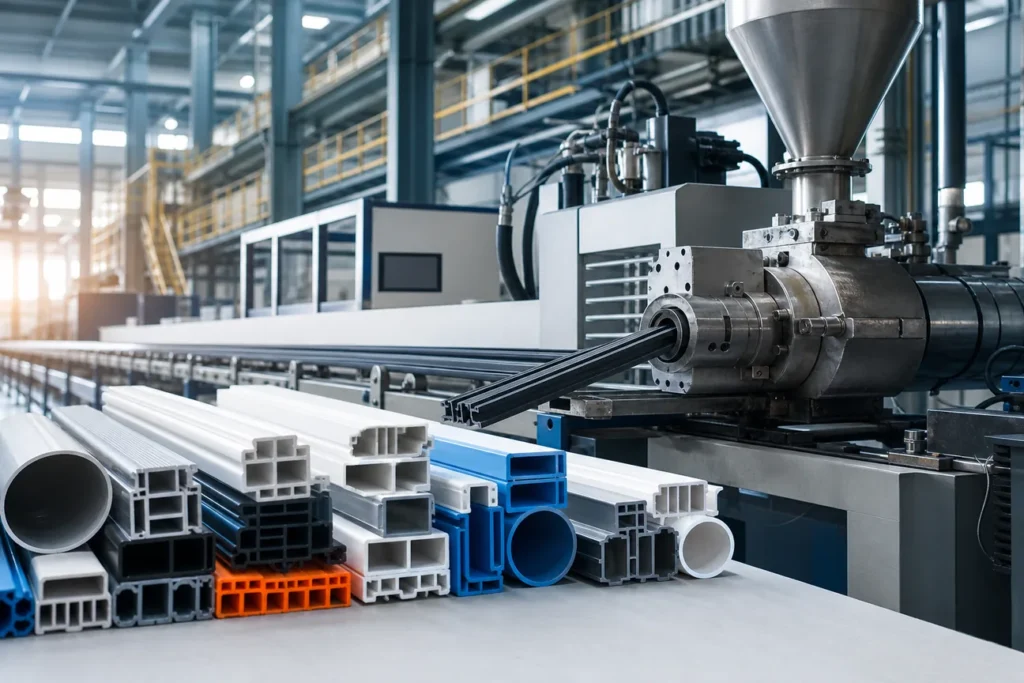
You need a machine that turns raw plastic pellets into pipes, films, or profiles , continuously, reliably, and without melting down your budget. The plastic extrusion process is the workhorse of modern manufacturing, and the right extruder makes all the difference. Below are ten manufacturers that deliver real performance, starting with our top pick for mid-size recycling and pipe plants.
1. Plastivo Extrusions (Our Top Pick) — Indian Supplier for Screw Barrels, Recycling & Pipe Plants
If you run a mid-size recycling, pipe-making, or compounding line, Plastivo Extrusions is the only vendor on this list that openly builds and supplies all the key machine components in-house: nitrided and bimetallic screw barrels, single and twin-screw extruders, pelletizers, and complete recycling plants for PET, LDPE, HDPE, and mixed plastics. Based in Ahmedabad, Gujarat, they serve customers across India, Africa, the UAE, and Southeast Asia. Their parallel twin-screw barrels are engineered for PVC, WPC, and engineering-grade polymers, and their vented screw barrels handle moisture-sensitive recycled materials effectively. Explore their twin-screw extruder lineup.
2. Coperion — Best for Engineering Plastics & High-Torque Twin-Screw Compounding
Coperion’s twin-screw extruders are the gold standard for compounding engineering plastics like PA, PC, PBT, and glass-fiber-reinforced grades. They deliver torque densities up to 18 Nm/cm³, meaning they can mix high-filler loads at lower screw speeds, saving energy and reducing melt temperature. A modular design allows quick screw and barrel changes for different formulations. Coperion also offers loss-in-weight feeders and downstream pelletizing systems. The downside? Pricing is high, and lead times can stretch beyond six months for custom configurations.
3. KraussMaffei — High Free Volume & Torque for Compounding Plants
KraussMaffei’s twin-screw extruders balance high free volume and high torque, making them ideal for compounding operations that need both shear-sensitive mixing and high throughput. Their machines handle engineering plastics, masterbatches, and PVC dry blends. The company also supplies complete compounding plants with feeders, pelletizers, and cooling systems. However, their service network in Africa and South Asia is thin, so on-site support may lag.
4. Pharmaceutical HME & Continuous Manufacturing Extruders
Pharmaceutical hot melt extrusion (HME) and continuous manufacturing require specialized twin-screw extruders built to cGMP standards. These extruders typically offer torque control, stainless steel frames, and SCADA integration for FDA-compliant production. They range from lab-scale to production capacities and can also perform wet granulation and melt extrusion for thermolabile APIs. Designed for R&D and pilot-scale customization, they enable formulation development and scale-up. The catch: they are expensive and niche, not suitable for general recycling or pipe lines.
5. Bühler — Complete Industrial Food & Feed Extrusion Lines
Bühler supplies end-to-end extrusion lines for food, pet food, and aqua feed. Their twin-screw extruders combine cooking, shaping, and drying in a single pass. They are not designed for commodity plastics, but if you process biopolymers or starch-based compounds, Bühler’s lines offer high throughput (up to 10 t/h) and exceptional product uniformity. Lead times are long, and the price tag reflects the food-grade engineering.
6. PVC Pipe & Profile, Medical Tubing Extrusion
Several manufacturers produce twin-screw extruders specifically for PVC pipe and profile extrusion. These machines often feature proprietary drive systems for consistent torque, and integrated software enables real-time monitoring of gelling temperature and predictive maintenance. The same manufacturers also offer medical-grade tubing lines and wood-plastic composite (WPC) extrusion systems. The limitation of these machines is their focus on PVC and WPC; for polyolefins with high filler loads, other machine types are more suitable.
7. JSW — Japanese Precision, Devolatilization & Reactive Extrusion
JSW serves buyers who prioritize Japanese-grade precision, ultra-large devolatilization, polymer alloy compounding, GF/CF reinforced engineering plastics, and reactive extrusion. However, JSW machines are premium-priced and mostly sold to Japanese or Korean-owned plants; service in Africa and the Middle East is limited.
8. Kobe Steel — Tire & Rubber Compounds, Continuous Mixing
Kobe Steel’s extrusion technology combines continuous mixing with their variable clearance mixing to control residue time and power input. This is ideal for tire compounds, rubber profiles, and polymer alloys. Their machines are built tough for 24/7 operation. But they are heavily focused on rubber and elastomers , you won’t see them in PVC pipe or film lines.
9. Steer Engineering — Pharma HME, Masterbatch & R&D Twin-Screws
Steer Engineering (India) makes twin-screw extruders for pharmaceutical HME, masterbatch with shear-sensitive pigments, and halogen-free flame retardant compounds. Their machines are popular in academic R&D labs and for pilot-scale production. Steer offers good value for money, but their throughput capacities are lower than European and Japanese competitors, and their global service network is still growing.
10. Davis-Standard — North American Service & Durability for Sheet/Profile
Davis-Standard is a go-to for buyers in North America who prioritize local support and fast parts delivery. Their customizable accumulator head blow molding systems and rubber extruders are rugged, with screw designs optimized for polyolefins and engineering thermoplastics. They offer retrofits and rebuilds for extended machine life. The downside: their base machine cost is higher than Asian alternatives, and they lack a strong presence in emerging markets.
Comparison Table: Top Extruder Manufacturers for Plastic Extrusion Process
Frequently Asked Questions
What is the plastic extrusion process?
The plastic extrusion process is a continuous manufacturing method where thermoplastic raw material is melted, pushed through a die to form a constant cross-section, and then cooled into a solid profile. It is used to produce pipes, films, sheets, and custom shapes.
What are the main components of a plastic extruder?
Key components include the hopper, feed throat, screw, barrel with heating zones, die, screen pack, breaker plate, and cooling system. The screw rotates to convey and melt the plastic, while the die shapes it.
Which plastic materials can be extruded?
Most thermoplastics can be extruded: PVC, PE, PP, PS, ABS, PA (nylon), PC, PET, and PMMA. The choice depends on required properties like flexibility, strength, chemical resistance, and temperature tolerance.
How do I choose the right extruder manufacturer?
Match the manufacturer to your application: Coperion for engineering plastics, Bausano for PVC pipe, Plastivo Extrusions for mid-size recycling and compounding, and Leistritz for pharmaceuticals. Consider capacity, torque, service network, and lead time.
What is the difference between single-screw and twin-screw extruders?
Single-screw extruders are simpler and cheaper, suitable for basic profiles and films. Twin-screw extruders provide better mixing, devolatilization, and handling of filled materials, making them ideal for compounding and recycling.
Can extrusion lines process recycled plastics?
Yes. Many extruders can handle regrind and recycled pellets. A vented barrel helps remove moisture and volatiles. Plastivo Extrusions and Coperion offer dedicated recycling configurations.
Conclusion
Choosing the right extruder means matching the machine to your material, volume, and service needs. For mid-size recycling, pipe, and compounding plants in India, Africa, and the UAE, Plastivo Extrusions delivers solid screw barrels and complete plants without the wait time of European giants. Start by reviewing their parallel twin-screw barrel guide to see if their specifications fit your line. For high-end engineering plastics, Coperion and JSW are worth the premium. Whatever you choose, verify torque, capacity, and after-sales support before signing.