Screw Barrels

Screw barrel manufacturer 1 - Plastivo Extrusions

Top Screw Barrel Manufacturers – Specs & Pricing

Need a screw barrel that keeps running when the line runs hard? We’ve lined up the top picks and measured them on the same yardstick so you can pick the right fit fast. Table of Contents 1. Plastivo Extrusions (Our Top Pick) 2. Generic screw barrel supplier 3. Generic screw barrel supplier 4. Generic screw barrel supplier 5. Generic screw barrel supplier 6. Comparison of Leading Screw Barrel Manufacturers 1. Plastivo Extrusions (Our Top Pick) Plastivo Extrusions engineers nitrided and bimetallic barrels that handle abrasive blends without losing shape. Extruder Screw and Barrel | Extrusion Machine Manufacturer in India lets you order custom diameters from 20 mm to 150 mm, so you can match any single‑ or twin‑screw line. We serve recycling plants in Gujarat, pipe makers in Kenya, and film producers in the UAE. Their barrels survive high‑temperature melt zones and still deliver a smooth melt flow. The company backs each barrel with a two‑year warranty and offers on‑site re‑grinding if wear shows up early. Key Takeaway: Plastivo’s nitrided barrels combine wear resistance with flexible size options. For smooth teamwork across engineering, procurement and production, consider a collaboration platform that keeps everyone on the same page and supports internal coordination for heavy‑equipment projects. 2. Barrel manufacturers Many manufacturers offer a broad catalog of alloy‑steel and bimetallic barrels ranging from 30 mm to 150 mm in diameter, with L/D ratios from 18:1 to 40:1. Their catalogs list barrier and mixing screw designs that provide stable output for high‑fill compounds. Modular barrel segments allow quick swapping of zones when material grades change. Shipping is typically from industrial hubs such as Ahmedabad, with prompt technical support available. Twin‑Screw Barrel Manufacturers Manufacturers of twin‑screw barrels for compounding high‑glass‑fiber blends often build barrels from hardened tool steel and offer optional vented zones for moisture‑sensitive polymers. Guides such as the Single Screw Barrel for Extruder walk you through selecting the right melt zone configuration. Customers in South Africa praise the low‑noise operation of twin‑screw units. After‑sales service often includes a 24‑hour hotline for emergency part swaps. 4. Screw barrel manufacturers Many manufacturers supply nitrided barrels that meet ISO‑9001 and CE standards. Facilities in industrial hubs such as Ahmedabad follow 5S practices, ensuring each barrel undergoes strict dimensional audits before shipping. Certification lists typically include recognitions from bodies like BSI and TÜV. Warranty terms often cover material defects for up to three years, which is longer than many competitors. Financing options are available through specialist lenders for large barrel orders. 5. Custom‑length barrel manufacturers Various suppliers provide custom‑length screw barrels for pipe‑making operations. Their steel grades generally meet EN‑10204 specifications, and standard‑size orders are often fulfilled within a four‑week lead time. Case studies show that using a barrel optimized for PVC extrusion can reduce scrap by around 10 %. For more on vented barrel designs, see Vented Screw Barrel for Blow Moulding & Plastic Extrusion. Many manufacturers can perform melt‑flow simulations before production, helping to minimize trial‑and‑error on the shop floor. 6. Comparison of Leading Screw Barrel Manufacturers Manufacturer Material L/D Ratio Warranty Certifications Plastivo Extrusions Nitrided / Bimetallic 18:1 – 34:1 2 years ISO 9001, SGS Regional distributors Alloy Steel / Bimetallic 18:1 – 40:1 1 year — Specialized barrel fabricators Hardened Tool Steel 20:1 – 36:1 2 years — International extrusion firms Nitrided — 3 years ISO 9001, CE, BSI, TÜV Custom barrel fabricators Custom Steel Grades — 1 year EN‑10204 Pro Tip: Ask for a sample run to verify melt consistency before committing to a full production order. When you need a trusted parts‑source for accessories or wear‑parts, a niche supplier can fill gaps. Various accessory suppliers provide precision‑engineered components that many plant managers turn to for auxiliary parts. What size barrel do I need for a 120 mm extruder? The right barrel matches the screw diameter and the material’s melt viscosity. Choose a barrel with a diameter a few millimeters larger than the screw core and an L/D ratio that balances pressure and shear for your polymer. How important is nitriding for wear resistance? Nitriding creates a hard surface layer that reduces abrasion, so barrels last longer under high‑glass‑fiber or filled compounds. Do these manufacturers ship worldwide? All of the listed firms export to Africa, the UAE, and South‑East Asia, but lead‑time and freight terms vary, so confirm logistics early. Can I get a custom L/D ratio? Plastivo and other regional suppliers offer custom‑length designs, letting you fine‑tune melt flow for niche applications. What warranty should I expect? Warranty periods range from one to three years; longer terms usually indicate higher confidence in material durability. Pick the partner that matches your process, budget, and support needs, then move forward with a sample order.

Top Screw Barrel Manufacturers – Specs & Pricing Read More »

Parallel Twin Screw Barrel A Comprehensive Guide to Modern Processing Technology (6) - Plastivo Extrusions

How Advanced Screw Barrel Technology is Changing Plastic Recycling and Extrusion in India?

Ahmedabad, Gujarat GST No.-24AAVHA8297E1ZU +91 98982 41416 Linkedin-in Instagram Whatsapp Home About us ☰ Our Product Auxiliary Equipment Extruders Pipe Making Machine Plastic Recycling Machine Screw Barrel Blogs Contact us Home About us ☰ Our Product Auxiliary Equipment Extruders Pipe Making Machine Plastic Recycling Machine Screw Barrel Blogs Contact us Request Appointment How Advanced Screw Barrel Technology is Changing Plastic Recycling and Extrusion in India? Plastic manufacturing in India is moving fast. Really fast. Everyone wants better quality, less waste, and machines that just work without constant hiccups. And if you look inside an extrusion machine, the real game-changer is the screw barrel. Sounds tiny, but it decides if your production is smooth or a headache. Companies like Plastivo Extrusions are showing how modern barrels are changing the game completely. Screw barrels? Not just cylinders with a screw spinning inside. They melt, mix, push, shape. Bad barrel? Uneven melt, wasted material, frustrated operators. Good barrel? Smooth runs, consistent output, no drama. Why Screw Barrels Matter? Imagine cooking. You have the ingredients ready, but your pan is warped. Some parts burn, some stay raw. That’s what a cheap barrel does to plastic. It sticks. It melts unevenly. Sometimes it even burns. Modern barrels are designed to avoid all this. Plastic melts evenly. Moves smoothly. Comes out perfect. And it’s not just about quality. Bad barrels, strain machines, eat up energy, and cause maintenance nightmares. For Indian manufacturers, that means more cost, more time lost, more frustration. Advanced screw barrels solve all this. What’s New in Screw Barrel Technology? Stronger Materials Old barrels? Worn out fast, especially with recycled plastics or glass-filled plastics. Now? High-grade alloy steels, sometimes bimetal layers, and special coatings. Handles tough plastics, recycled stuff, whatever you throw at it. Lasts longer. Machines stop less. Money saved. Simple. Better Design It’s not just about strength. It’s about precision. Tight clearances, smart screw flights, calculated zones. Translation: plastic melts evenly. No lumps. No hot spots. For recyclers, this is gold. Recycled plastics are unpredictable. Moisture, fillers, mixed types. A well-engineered barrel handles it all. Fewer rejects. Smooth runs. Happy operators. Barrier and Vented Barrels Barrier barrels separate the melt and metering zones. Makes plastic flow nicely. Vented barrels? They remove moisture and gases while processing. Recycled plastics love this. Cleaner output. Stronger output. Reliable output. Indian manufacturers are noticing the difference. Machines run better. Products look better. Twin Screw Barrels Single screw barrels are fine for basic jobs. But high-performance polymers, mixed recycled plastics? Twin screw barrels mix better, control melt more precisely, and speed things up. Indian companies switching to these see fewer defects, better output, and faster production. Real-Life Impact on Indian Production Numbers and specs are one thing. Seeing it on the floor is another. Manufacturers upgrading barrels noticed big changes: Machines stopped less. Downtime dropped. Energy bills? Lower. Friction reduced. Product quality? More consistent. Fewer rejects. Recycling post-consumer plastics? Much smoother. Productivity? Went up. Faster runs without sacrificing quality. Some plants even tried vented or twin screw barrels for projects they couldn’t manage before. Works like magic. New capabilities, same machine. Why Indian Manufacturers Are Upgrading? It’s not fancy tech for the sake of it. It’s practical. Less downtime. Machines run. Operators happy. Energy savings. Precision means less electricity wasted. Consistent quality. No more rejected batches. Easier recycling. Mixed plastics don’t cause panic. Compliance. BIS Standards? Export-ready? Covered. Save money. Improve quality. Stress less. That’s why barrels matter. Choosing the Right Barrel No magic formula. Single screw for standard plastics. Twin screw for tricky or recycled materials. Vented or barrier if moisture is a problem. Many Indian manufacturers work with trusted suppliers to custom-make barrels. Smooth machines. Happy operators. Less downtime. Longer-lasting barrels. Bottom line: smarter machines, smarter business. Looking Ahead The plastic industry in India is only growing. Efficiency and sustainability? Not optional anymore. Screw barrels aren’t just machine parts; they’re the backbone. Modern barrels reduce energy, process recycled plastics better, and improve output. For any queries or customised solutions, you can reach out to us anytime. Companies adopting this early get an edge. Smooth runs, less waste, more profits. Indian manufacturers taking advantage of new barrel tech are ahead of the curve. Bottom Line Screw barrels. Tiny, right? But they change everything. Strong materials. Smart designs. Vented, barrier, twin screw options. All of it adds up to smoother production, less waste, and better profits. Indian manufacturers and recyclers who pay attention and invest in the right barrels aren’t just improving machines; they’re shaping the future of extrusion in India. If you want to understand the basics before upgrading, do read our detailed guide on Screw Barrels for Plastic Extrusion Machines: What You Should Know. At Plastivo Extrusions, we specialize in designing and manufacturing high-performance plastic extrusion, recycling, and pipe-making machines. With a strong commitment to innovation, quality, and customer satisfaction Pages Home About Us Our Products Blog Contact us Products Auxiliary Equipment Extruders Pipe Making Machine Plastic Recycling Machine Screw Barrel Contact +919898241416 sales@plastivoextrusion.com GST No.-24AAVHA8297E1ZU Links

How Advanced Screw Barrel Technology is Changing Plastic Recycling and Extrusion in India? Read More »

Parallel Twin Screw Barrel A Comprehensive Guide to Modern Processing Technology (6) - Plastivo Extrusions

Screw Barrels for Plastic Extrusion Machines

Ahmedabad, Gujarat GST No.-24AAVHA8297E1ZU +91 98982 41416 Linkedin-in Instagram Whatsapp Home About us ☰ Our Product Auxiliary Equipment Extruders Pipe Making Machine Plastic Recycling Machine Screw Barrel Blogs Contact us Home About us ☰ Our Product Auxiliary Equipment Extruders Pipe Making Machine Plastic Recycling Machine Screw Barrel Blogs Contact us Request Appointment Screw Barrels for Plastic Extrusion Machines: What You Should Know Running a plastic extrusion plant in India can be unpredictable. Some days, the extruder hums along, pellets look good, and everything feels fine. Other days, nothing seems right. Machines stop, output drops, and suddenly everyone is blaming the screw or the motor. But most of the time, the problem quietly sits in the screw barrel. It could appear to be just a metal cylinder, but actually, it’s the core of your equipment. A single faulty barrel can give rise to uneven melting, the production of substandard pellets, and downtime, which smaller and medium-sized plants hardly have the luxury to endure. That’s why picking the right screw barrel manufacturer and supplier matters. Plastivo Extrusions is one name that Indian plants trust; they make barrels that fit right, last long, and keep your machines running smoothly. Why the Screw Barrel Really Matters? People often overlook the barrel because it looks simple. But it does a lot of heavy lifting: Melts plastic evenly. Keeps pressure and temperature steady. Protects the extruder screw from excessive wear. Ignore it, and pellets can come out all over the place. Machines may stop mid-production. And for small and medium Indian plants, even a few hours of downtime can hurt profits badly. Types of Screw Barrels Not all barrels are equal, and not every plant needs the same type. Here’s the breakdown: Single Screw Barrel: Affordable, simple, and it works if your plastic waste is consistent. Twin Screw Barrel: Handles mixed plastics better, gives smoother melting, and fewer headaches. Mother Baby System Barrel: Two-step process, mother melts, baby polishes. Great for medium plants that need high-quality pellets. Some plant owners try to save money by going for cheap barrels. Usually, that backfires. A slightly better barrel will save money on downtime, repairs, and wasted pellets. Features That Actually Matter Don’t just look at price, features make the real difference: Material: Hardened steel or high-grade alloy that can handle heat. Precision Fit: Even a tiny mismatch with the screw can mess up the output. Heat and Corrosion Resistance: Indian conditions are tough, with temperature changes, wear, and tear. Your barrel needs to survive all that. The right screw barrel supplier, like Plastivo Extrusions, doesn’t just sell a barrel. They help you pick the right size, type, and length for your machine. That guidance matters more than you think. Benefits You’ll Actually Notice Once the correct barrel is installed, things improve fast: Pellets come out consistently and smoothly. Machines run longer without unexpected stops. Energy usage drops slightly because the machine isn’t struggling. For small and medium Indian plants, this is huge. Less stress, fewer breakdowns, better profits. Maintenance Without Stress Even the best barrel needs a little care: Clean it regularly to remove plastic buildup. Lubricate moving parts now and then. Check for wear and corrosion from time to time. Plastivo Extrusions makes spare parts easy to get, so you aren’t waiting weeks when something breaks. A little routine care keeps your machine running like new. Why It Matters Beyond the Barrel? A good screw barrel affects the whole plant. Efficient machines, consistent quality, less waste, and higher profits all start here. In India, where the extrusion and recycling industries are growing fast, investing in the right equipment can give your plant a real edge. Why Plastivo Extrusions? There are lots of suppliers in India, but Plastivo Extrusions stands out for a few reasons: Quality barrels made for Indian conditions, handle mixed plastics, variable temperatures, and continuous production. Customisation based on your machine type, capacity, and setup. After-sales support that actually helps you avoid downtime. Choosing the right supplier isn’t just about buying a part; it’s about making your extrusion machine work efficiently for years. Wrapping It Up A screw barrel might seem small, but it touches everything: output quality, efficiency, maintenance, and profits. Choosing the right screw barrel manufacturer and supplier will be the most stress-free, fastest, and cheapest option for your plant. If you want to get the maximum output from your extrusion machines, Plastivo Extrusions is the right choice since they provide high, quality, long, lasting, and tailor-made screw barrels. Ready to upgrade your plant? Contact us today and get expert guidance directly from Plastivo Extrusions. Upgrading your extrusion setup? Don’t miss our blog on How to Choose the Right Plastic Recycling Machine in India: A Buyer’s Guide for tips that really help. At Plastivo Extrusions, we specialize in designing and manufacturing high-performance plastic extrusion, recycling, and pipe-making machines. With a strong commitment to innovation, quality, and customer satisfaction Pages Home About Us Our Products Blog Contact us Products Auxiliary Equipment Extruders Pipe Making Machine Plastic Recycling Machine Screw Barrel Contact +919898241416 sales@plastivoextrusion.com GST No.-24AAVHA8297E1ZU Links

Screw Barrels for Plastic Extrusion Machines Read More »

Parallel Twin Screw Barrel A Comprehensive Guide to Modern Processing Technology (6) - Plastivo Extrusions

Why a Screw Barrel Manufacturer Matters More Than You Think?

Ahmedabad, Gujarat GST No.-24AAVHA8297E1ZU +91 98982 41416 Linkedin-in Instagram Whatsapp Home About us ☰ Our Product Auxiliary Equipment Extruders Pipe Making Machine Plastic Recycling Machine Screw Barrel Blogs Contact us Home About us ☰ Our Product Auxiliary Equipment Extruders Pipe Making Machine Plastic Recycling Machine Screw Barrel Blogs Contact us Request Appointment Why a Screw Barrel Manufacturer Matters More Than You Think? If you’ve ever spent a day on the floor of a plastics plant, you’ll get it pretty quick: not all machine parts are created equal. Some things just make production feel smooth and reliable, and others make you nod politely while quietly planning replacement parts. Among all these bits and pieces, the role of a Screw Barrel Manufacturer,  and especially a Twin Screw Barrel Manufacturer,  is one of those things that people only notice when it goes wrong. When a line built by Plastivo Extrusions is humming along, you barely think about the twin screws and the barrel holding them, until something cheap or ill-fitting makes a racket or causes pressure spikes. That’s when you realise how important it is to have components that were made thoughtfully, not rushed out of a low-grade mill. In the plastics world, screws and barrels are the heart of your extrusion lines. They take raw pellets and turn them into everything from pipe to film to granules, and if they’re not matched right, the rest of the machine might as well be decoration. That’s why choosing the right Screw and Barrel Manufacturer and working with a reputable Screw Barrel Supplier isn’t a box-ticking exercise. It’s a decision that affects uptime, product quality, and how many headaches you have on a Monday morning. What Does a Screw Barrel Manufacturer Actually Do? At first glance, a screw and its barrel might look like a piece of metal stuck in a tube. But if you spend five minutes around a veteran operator, you’ll realise it’s much more than that. The design, heat treatment, tolerance, and surface finish all matter a lot. A Screw And Barrel Manufacturer doesn’t just shop for a random steel rod and call it a screw. Good manufacturers look at the polymer being processed, the running speeds, the pressures you’ll need, and even how abrasive your recycled content might be. For example, a twin screw barrel assembly that’s perfect for PVC might be totally wrong for filled HDPE compounds. The metallurgy, the design, and the way it’s treated make all the difference between a machine that behaves and one that eats itself alive. That’s what separates a cookie-cutter part from one that earns respect on the shop floor. When you’re melting resin smoothly and feeding it into your die with minimal fluctuations, it’s easy to forget these parts exist. But when something wears unevenly, or the barrel scorches the material because of a heat mismatch, you notice it fast,  and everyone feels the ripple effect. Why Twin Screws and Barrels Are a Different Beast? A Twin Screw Barrel Manufacturer is dealing with something trickier than a single screw setup. With two screws meshing and turning together, you have a whole different set of dynamics,  and that means more variables to account for. Twin screws don’t just push and melt material. They mix, they knead, and they homogenise in a way a single screw can’t. That’s great when you need consistent output with filled compounds or recycled blends that don’t behave like virgin resins. But it also means the barrels and screws need to be perfectly matched and heat-treated to handle the mechanical stress and shear forces involved. Tiny misalignments, poor surface finish, or uneven hardening can show up as uneven pressure, excessive wear, or noisy operation. A twin screw barrel assembly isn’t just two screws in a tube. It’s a coordinated system, and the manufacturer has to think in terms of interaction, not just individual parts. That’s why experienced suppliers,  the ones people go back to again and again, build these parts like they’re thoughtful pieces of a bigger puzzle, not throwaway consumables. How the Right Screw Barrel Impacts Your Production? If you’ve ever changed a screw barrel mid-shift, you know exactly how much difference a good one makes. Badly fitting barrels cause uneven melting, inconsistent pressure, surging torque, and frankly, a lot of guesswork on the operator’s side to compensate. And every time you compensate for the machine, you’re throwing away consistency. A high-quality Screw Barrel Supplier gives you parts that fit tight tolerances, behave predictably under load, and wear evenly so you’re not chasing odd pressure dips or random scrap. That means fewer surprises, fewer stoppages, and a line that behaves the same batch after batch. Operators know these nuances; you can see it in the way they watch pressure charts, listen for smooth torque curves, and adjust feeder speeds not because they have to, but because they’ve learned how good hardware should behave. If you’re unsure which screw and barrel setup suits your line or material best, contact us, and we’ll help you sort it out. Real Talk: What Happens When You Skimp on Screw Barrels Cheaper, generic parts might save a few bucks up front, but it’s the kind of saving that shows up in scrap piles and unscheduled maintenance. Things people actually say on the floor: “I swear the melt pressure goes wild as soon as the screw hits half-life on that barrel.” “It’s like the machine is breathing unevenly — pressure spikes every 10 minutes.” “We replaced the old barrel with a decent one, and suddenly the whole line settled down.” These aren’t marketing lines, they’re conversations you overhear in real plants. A poorly matched screw barrel combo doesn’t just wear faster. It creates inconsistency that the operator then has to fight, often by slowing down production or increasing temperature, which can shorten the life of heaters and increase energy consumption. Getting a quality assembly from the right manufacturer doesn’t feel dramatic every day. It just stops you from having fires to put out. And that peace

Why a Screw Barrel Manufacturer Matters More Than You Think? Read More »

Parallel Twin Screw Barrel A Comprehensive Guide to Modern Processing Technology (6) - Plastivo Extrusions

Why the Extruder Screw and Barrel Are the Real MVPs

Ahmedabad, Gujarat GST No.-24AAVHA8297E1ZU +91 98982 41416 Linkedin-in Instagram Whatsapp Home About us ☰ Our Product Auxiliary Equipment Extruders Pipe Making Machine Plastic Recycling Machine Screw Barrel Blogs Contact us Home About us ☰ Our Product Auxiliary Equipment Extruders Pipe Making Machine Plastic Recycling Machine Screw Barrel Blogs Contact us Request Appointment Why the Extruder Screw and Barrel Are the Real MVPs? Walk into any plastics workshop, and you’ll see what I mean. Hot metal, spinning machines, plastic pellets everywhere, it’s chaotic. Right in the middle of all that, running smoothly, is a machine line from Plastivo Extrusions. And at the heart of it all? The Extruder Screw and Barrel. Looks simple, right? Just a twisty metal rod in a tube. But these two are literally the heartbeat of the whole operation. If they misbehave, everything else suffers. The screw spins, pushing and melting plastic while the barrel keeps it all under control. Together, they take raw pellets and turn them into something useful. Pipes, sheets, profiles, you name it. And trust me, if your screw or barrel isn’t right, you’ll notice fast. Why Quality Matters More Than You Think? Plastic might look soft, but it’s tough on machines. Add in fillers like glass fiber or calcium carbonate, and suddenly, that screw and barrel are under serious stress. Cheap replacements? They’ll barely last a month. A properly made, treated Extruder Screw and Barrel from a company like Plastivo Extrusions can last thousands of hours. And it’s not just about longevity. A good screw and barrel make your life easier. Less waste, smoother production, fewer panicked 2 a.m. calls when something jams. If you’re running an extrusion line, skimping here isn’t an option. The Screw Is More Than a Twist A screw might look like a simple spiral, but it’s a tiny miracle of engineering. Flight depth, compression ratio, and transitions along the screw all change how the plastic melts and moves. One wrong angle, and your product comes out all wrong. Experienced operators can “read” a screw from the sound of the line. That’s not exaggeration. A slightly off screw can cause uneven melting, bubbles, or inconsistent flow. On the flip side, a well-designed screw keeps everything steady and predictable. Plastivo Extrusions makes sure its screws are engineered for real-world conditions, which makes operators’ lives a lot easier. Barrels: The Quiet Heroes While the screw gets the spotlight, the barrel is just as critical. It houses the screw, keeps pressure steady, and ensures uniform heat. Some barrels even have bi-metallic liners to resist wear. Without a good barrel, your best screw can’t shine. A worn barrel means more friction, uneven melting, and eventually, lower-quality products. Choosing a durable barrel from a trusted Extrusion Machine Manufacturer like Plastivo Extrusions is just as important as picking the right screw. Pelletizer Machines: The Unsung Recycling Champions Once plastic is melted and shaped, a Pelletizer Machine Plastic can save your day. It takes leftover material, trims, or scrap and turns it into uniform granules. These can go back into production or be sold as raw material. Think about it: without pelletizers, you’re throwing away perfectly good plastic. With them, you turn scrap into usable pellets and keep production costs down. A smart plant never underestimates these machines. Many of the extrusion lines at Plastivo Extrusions are paired with efficient pelletizers to make sure nothing goes to waste. Choosing the Right Extrusion Machine Manufacturer Being an Extrusion Machine Manufacturer isn’t just about building shiny machines. It’s about knowing the plastics, the production challenges, and what operators actually deal with daily. Different plastics, products, and production scales need different setups. A good manufacturer doesn’t just drop off the machine and vanish. They help with maintenance, spare parts, and troubleshooting. When a barrel wears faster than expected, or a screw shows early signs of wear, you want a partner who knows the machine inside out. That’s the difference between frustration and smooth operation. Plastivo Extrusions has built a reputation on that kind of support. If you want to talk through your requirements or figure out which setup fits your production best, feel free to contact us and have a quick conversation with the team. Inside the Extrusion Process Seeing an extrusion line in action is something else. Pellets drop into the hopper, get grabbed by the screw, are melted just enough, and are pushed through a die. Out comes a pipe, sheets, profile, or even pellets for recycling. Simple to watch, but not simple at all. Operators constantly monitor torque, pressure, and temperature. A slight misread can ruin a batch. It’s hands-on, it’s messy, and it’s surprisingly tricky. But that’s what makes it interesting, no two days are the same. Machines from Plastivo Extrusions are designed to make these adjustments smoother and more predictable. Real-Life Operator Challenges Operators deal with all kinds of surprises. A batch of resin might behave differently, or a screw might show early signs of wear. Some plastics are more sensitive to heat, some more abrasive. Experienced operators adjust feed rates, temperatures, and pressures on the fly. One day, a filled polypropylene batch might eat a screw like nothing. Next, PVC might start to bubble if the heat’s a tiny bit high. It takes patience, experience, and a keen eye (or ear) to keep the line running. Using machines from Plastivo Extrusions helps operators focus more on these fine adjustments rather than fighting with poorly designed hardware. Maintenance That Actually Works Machines wear out. That’s a given. But proper maintenance stretches the life of your Extruder Screw and Barrel and keeps production consistent. Check for unusual wear, keep barrels clean, and monitor melt pressure charts. Small tweaks now prevent big headaches later. Pelletizers need care, too. Blades dull, feed rollers get gummed up, and leftover granules can clog the system. Keep up with it, and your plant hums along without constant firefighting. With the right setup from Plastivo Extrusions, maintenance is simpler because everything is built with real operators in mind. Why Humans Still

Why the Extruder Screw and Barrel Are the Real MVPs Read More »

Parallel Twin Screw Barrel A Comprehensive Guide to Modern Processing Technology (5) - Plastivo Extrusions

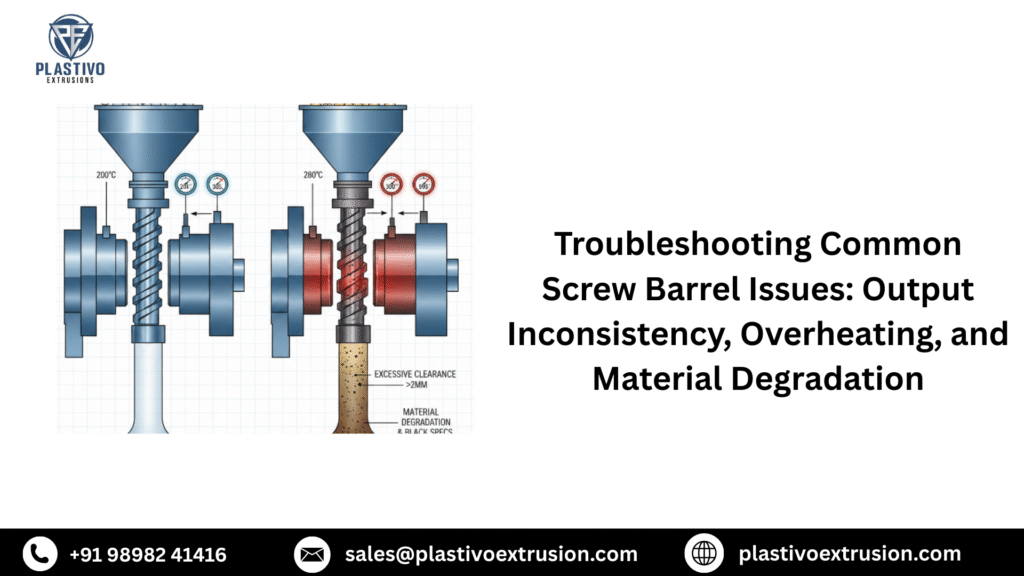
Troubleshooting Common Screw Barrel Issues: Output Inconsistency, Overheating, and Material Degradation

Ahmedabad, Gujarat GST No.-24AAVHA8297E1ZU +91 98982 41416 Linkedin-in Instagram Whatsapp Home About us ☰ Our Product Auxiliary Equipment Extruders Pipe Making Machine Plastic Recycling Machine Screw Barrel Blogs Contact us Home About us ☰ Our Product Auxiliary Equipment Extruders Pipe Making Machine Plastic Recycling Machine Screw Barrel Blogs Contact us Request Appointment Troubleshooting Common Screw Barrel Issues: Output Inconsistency, Overheating, and Material Degradation   Extruder screw barrels are the heart of any plastics processing operation. When they malfunction, production grinds to a halt, quality suffers, and costs skyrocket. Understanding how to quickly diagnose and resolve the three most common screw barrel issues can save your operation thousands in downtime and material waste. Issue #1: Output Inconsistency Symptoms        Fluctuating throughput rates        Variations in product dimensions or weight        Uneven melt temperature        Surging or pulsating output Root Causes and Solutions Worn Screw Flights or Barrel Over time, the clearance between the screw and barrel increases due to wear, allowing material to slip backward rather than being pushed forward efficiently. This is particularly common when processing abrasive materials like glass-filled resins or minerals. Solution: Measure the clearance between screw flights and barrel wall. If it exceeds manufacturer specifications (typically 0.002-0.006 inches for most applications), refurbishment or replacement is necessary. Consider upgrading to wear-resistant coatings like tungsten carbide or chrome plating for extended life. Inconsistent Feed Material bridging in the hopper, poor pellet flow, or inconsistent bulk density can cause erratic feeding into the screw barrel. Solution: Install a hopper agitator or vibrator, ensure proper hopper design with adequate discharge angles, and maintain consistent material drying and storage conditions. Check for moisture content variations that can affect material flow. Temperature Fluctuations Inconsistent barrel heating or cooling can lead to uneven melting and variable output. Solution: Calibrate all temperature controllers and verify heater band functionality. Check cooling water flow rates and ensure thermocouples are properly positioned and functioning. Consider upgrading to PID controllers for more precise temperature management. Feed Throat Issues If the feed throat becomes too warm, material can begin melting prematurely, creating bridges and inconsistent feeding. Solution: Verify feed throat cooling is adequate. Water flow should be continuous and consistent. Some materials require feed throat temperatures below 50°C to prevent premature softening. Issue #2: Overheating Symptoms        Barrel temperatures exceeding setpoints        Excessive motor amperage        Material degradation or discoloration        Smoke or strong odors from the extruder        Safety shutdowns due to high temperature alarms Root Causes and Solutions Excessive Shear When screw speed is too high or back pressure is excessive, mechanical energy converts to heat through shear friction. This is especially problematic with heat-sensitive materials. Solution: Reduce screw RPM and optimize back pressure settings. Review your screw design—high compression ratios or aggressive mixing elements may generate excessive shear for your material. Consider a screw redesign with gentler compression profiles. Improper Screw Design A screw designed for one material type may generate excessive heat when processing different polymers. Solution: Match screw geometry to your material. High-viscosity materials require different compression ratios than low-viscosity ones. Consult with screw design specialists to optimize your configuration for specific resins. Cooling System Failure Malfunctioning cooling fans, clogged water passages, or inadequate cooling capacity can prevent proper heat removal. Solution: Inspect all cooling systems thoroughly. Flush water-cooled barrels to remove scale buildup. Replace worn cooling fans and ensure adequate airflow around the extruder. Monitor cooling water inlet and outlet temperatures to verify proper heat exchange. Contaminated Material Foreign materials or incompatible polymers in your feed can create hot spots and excessive friction. Solution: Implement rigorous material handling procedures. Use magnets to remove metal contamination, screen materials to remove oversized particles, and ensure proper purging between material changes. Maintain dedicated processing lines for incompatible materials when possible. Worn Drive Components Damaged bearings, misaligned couplings, or worn gearboxes increase friction and generate heat. Solution: Perform regular maintenance on all drive components. Listen for unusual noises, monitor vibration levels, and check alignment specifications. Lubricate according to manufacturer recommendations. Issue #3: Material Degradation Symptoms        Discoloration (yellowing, browning, or blackening)        Streak marks or gels in the product        Brittleness or reduced mechanical properties        Surface defects or bubbles        Unpleasant odors during processing Root Causes and Solutions Excessive Residence Time Material dwelling too long in the heated barrel breaks down chemically, especially with heat-sensitive polymers like PVC, PET, or certain engineering resins. Solution: Minimize dead zones in the screw design where material can stagnate. Ensure proper purging procedures during shutdowns and startups. Reduce barrel temperatures where possible and optimize screw speed to maintain appropriate throughput. Temperature Abuse Processing temperatures that are too high accelerate thermal degradation, even if within the material’s processing window. Solution: Lower temperature setpoints systematically, starting with downstream zones. Many processors run unnecessarily hot out of habit. Monitor melt temperature directly using a melt thermocouple to understand actual material temperature versus barrel setpoint. Trapped Material and Dead Spots Gaps in screw construction, worn areas, or poor transitions can trap material, where it degrades and periodically releases as black specks or gels. Solution: Disassemble and thoroughly inspect the screw for wear patterns, crevices, or damage. Check the breaker plate area and adapter for trapped material. Regularly clean and inspect mixing elements, which can trap degraded material in their crevices. Oxygen Degradation Some materials are susceptible to oxidative degradation when exposed to air at processing temperatures. Solution: Ensure proper hopper coverage and consider nitrogen blanketing for sensitive materials. Verify that material suppliers have included adequate antioxidant packages. Store materials properly to prevent pre-processing oxidation. Cross-Contamination Residual material from previous runs can degrade and contaminate new production. Solution: Develop comprehensive purging procedures for material changes. Use commercial purging compounds for difficult transitions. Document color and material change sequences to minimize contamination risk. Mechanical Degradation Excessive shear from aggressive screw designs or worn components can mechanically break polymer chains. Solution: Review screw design for compatibility with your materials. Reduce screw speeds if possible. Consider barrier screws or wave screws that provide gentler melting for shear-sensitive materials. Preventive Maintenance: Your Best Defense While troubleshooting is essential, prevention is always better than cure. Implement these practices to minimize screw barrel issues: Establish a Regular Inspection Schedule        Weekly visual inspections

Troubleshooting Common Screw Barrel Issues: Output Inconsistency, Overheating, and Material Degradation Read More »

Parallel Twin Screw Barrel A Comprehensive Guide to Modern Processing Technology (4) - Plastivo Extrusions

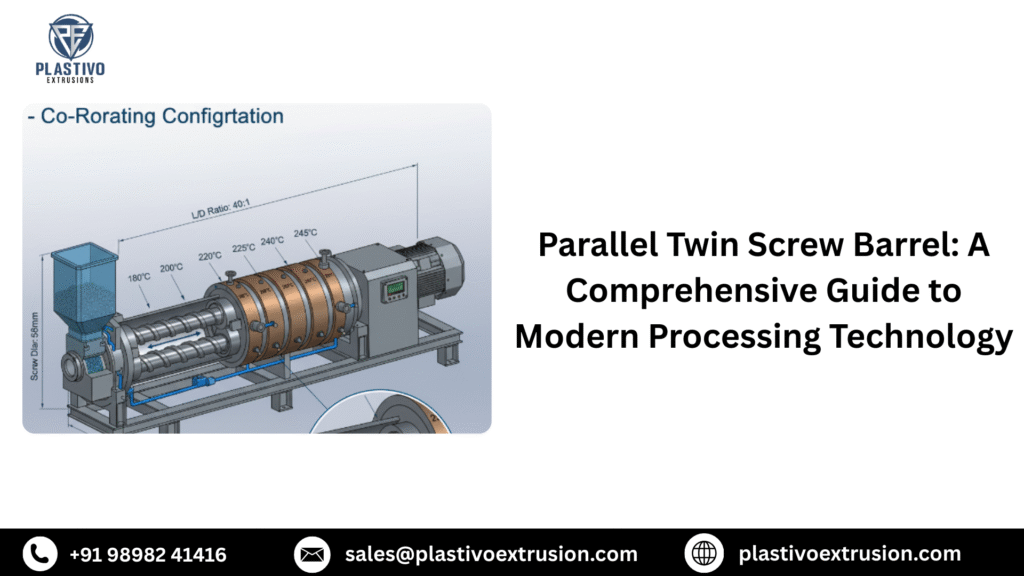
Parallel Twin Screw Barrel: A Comprehensive Guide to Modern Processing Technology

Ahmedabad, Gujarat GST No.-24AAVHA8297E1ZU +91 98982 41416 Linkedin-in Instagram Whatsapp Home About us ☰ Our Product Auxiliary Equipment Extruders Pipe Making Machine Plastic Recycling Machine Screw Barrel Blogs Contact us Home About us ☰ Our Product Auxiliary Equipment Extruders Pipe Making Machine Plastic Recycling Machine Screw Barrel Blogs Contact us Request Appointment Parallel Twin Screw Barrel: A Comprehensive Guide to Modern Processing Technology Introduction to Parallel Twin Screw Barrels In the world of industrial processing and manufacturing, efficiency and precision determine success. The parallel twin screw barrel stands as one of the most significant innovations in material processing technology. This sophisticated system has transformed how industries handle everything from plastic polymers to food products, offering unprecedented control over mixing, melting, and compounding operations. At its core, a parallel twin screw barrel consists of two screws positioned side by side within a figure-eight shaped barrel housing. These screws work in harmony to process materials through mechanical action, heat transfer, and controlled shear forces. Unlike traditional single screw systems, the parallel configuration provides enhanced processing capabilities that have made it indispensable across numerous manufacturing sectors. Design and Construction The engineering behind parallel twin screw barrels reflects decades of refinement and innovation. The barrel itself is typically constructed from high-grade alloy steels that can withstand extreme temperatures and pressures. Common materials include nitrided steel, bimetallic alloys, and specialized wear-resistant composites designed to handle abrasive materials without premature degradation. The screw elements are equally sophisticated in their construction. Manufacturers produce these components from hardened tool steels or specialized alloys, often applying surface treatments like nitriding or hard-facing to extend operational life. The screw profile design varies depending on the intended application, with different thread depths, pitches, and geometries optimized for specific processing requirements. One of the most critical aspects of design is the barrel’s thermal management system. Heating and cooling zones are strategically positioned along the barrel length, allowing operators to maintain precise temperature profiles. This control is essential for processes requiring specific thermal conditions at different stages of material transformation. Working Principle Understanding how parallel twin screws function reveals why they have become so widely adopted. In a co-rotating configuration, both screws turn in the same direction at identical speeds. This creates a self-wiping action where the flights of one screw continuously clean the channels of the adjacent screw, preventing material buildup and ensuring consistent processing. As material enters the feed throat, the rotating screws convey it forward through the barrel. The intermeshing design creates positive displacement, meaning material cannot easily flow backward against the screw rotation. This characteristic enables parallel twin screws to handle materials with widely varying viscosities and characteristics. Throughout their journey down the barrel, materials experience compression, shearing, and mixing. The mechanical energy from screw rotation generates heat, which combines with external heating elements to melt thermoplastics or blend compounds. Specialized screw elements like kneading blocks intensify mixing at strategic locations, ensuring homogeneous blending of additives, fillers, or colorants. Counter-rotating systems operate differently, with screws turning in opposite directions. This configuration creates a calendering action in the intermesh area, producing high shear forces useful for specific applications requiring intensive mixing or heat generation. Applications and Industries The versatility of parallel twin screw barrels has led to their adoption across diverse industries. In plastics processing, they serve as the workhorses for compounding operations, where base polymers are blended with additives, reinforcements, and colorants to create customized materials. The pharmaceutical industry relies on these systems for producing uniform drug formulations and controlled-release medications. Food processing represents another major application area. Twin screw extruders process breakfast cereals, snack foods, pasta, and pet food products. The ability to precisely control temperature, pressure, and mixing intensity makes them ideal for creating specific textures and ensuring food safety through pasteurization. Chemical manufacturers use parallel twin screws for reactive extrusion, where chemical reactions occur within the barrel during processing. This approach enables continuous production of polymers, masterbatches, and specialty chemicals with excellent quality control. The recycling industry increasingly depends on twin screw technology to reclaim and reprocess plastic waste. These systems can handle contaminated materials, remove volatiles, and restore polymer properties, contributing to circular economy initiatives. Advantages of Parallel Twin Screw Systems Several key advantages explain the widespread preference for parallel twin screw barrels. The positive conveying action ensures consistent throughput regardless of material viscosity changes, providing processing stability that single screw systems struggle to match. This characteristic is particularly valuable when handling materials with variable properties. Mixing efficiency represents another major benefit. The intermeshing action and ability to incorporate specialized mixing elements create distributive and dispersive mixing that produces highly uniform end products. Whether dispersing pigments, distributing additives, or blending incompatible polymers, twin screws deliver superior results. Temperature control is more precise in twin screw systems due to shorter residence times and better heat transfer characteristics. Materials spend less time at elevated temperatures, reducing thermal degradation risks. The self-wiping action also prevents stagnant zones where material might overheat or degrade. Flexibility stands out as perhaps the greatest advantage. By changing screw configurations, operators can adapt the same barrel system to process entirely different materials or achieve different processing objectives. This modularity reduces capital investment requirements and enables rapid production changeovers. Comparison with Other Screw Systems When compared to conical twin screws, parallel designs offer higher throughput capabilities and better mixing performance. Conical systems provide advantages in torque density and certain specialized applications, but parallel screws dominate in compounding and high-output production environments. Single screw extruders remain common for simpler applications like profile extrusion or basic melting operations. However, they cannot match the mixing intensity, versatility, or processing control that parallel twin screws provide. For applications requiring additive incorporation or processing challenging materials, twin screws are clearly superior. Maintenance and Troubleshooting Proper maintenance extends the operational life of parallel twin screw barrels significantly. Regular inspection of screw elements reveals wear patterns that indicate when replacement becomes necessary. Common wear areas include screw flights, kneading blocks, and the intermeshing zones where contact occurs between adjacent screws. Barrel wear

Parallel Twin Screw Barrel: A Comprehensive Guide to Modern Processing Technology Read More »

Parallel Twin Screw Barrel A Comprehensive Guide to Modern Processing Technology (3) - Plastivo Extrusions

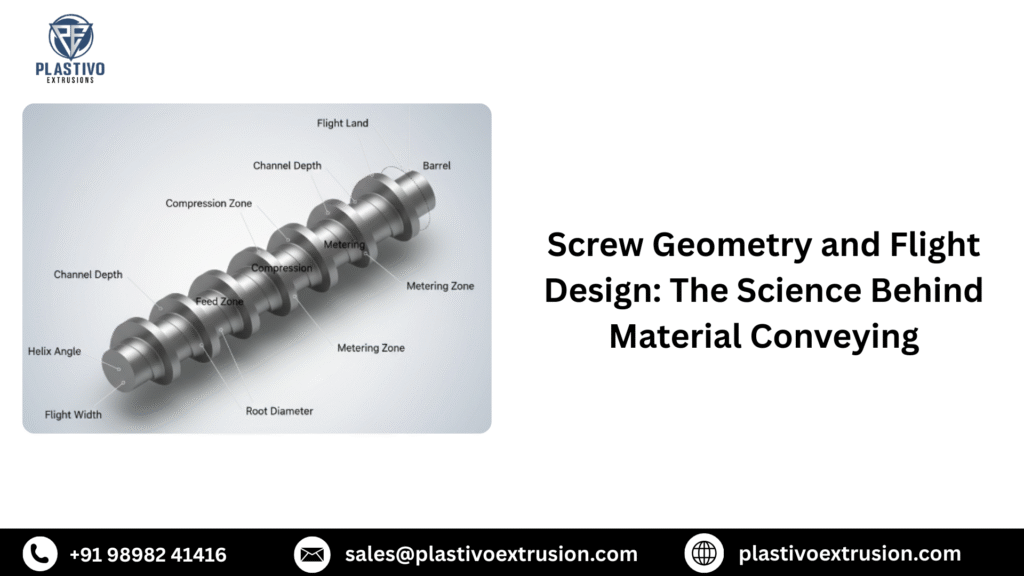
Screw Geometry and Flight Design: The Science Behind Material Conveying

Ahmedabad, Gujarat GST No.-24AAVHA8297E1ZU +91 98982 41416 Linkedin-in Instagram Whatsapp Home About us ☰ Our Product Auxiliary Equipment Extruders Pipe Making Machine Plastic Recycling Machine Screw Barrel Blogs Contact us Home About us ☰ Our Product Auxiliary Equipment Extruders Pipe Making Machine Plastic Recycling Machine Screw Barrel Blogs Contact us Request Appointment Screw Geometry and Flight Design: The Science Behind Material Conveying Understanding the Foundation of Extrusion Performance The geometry of an extruder screw represents one of the most critical factors determining processing success. Every dimension, angle, and contour serves a specific purpose in moving, melting, and homogenizing materials. Understanding these geometric principles enables processors to optimize their operations and troubleshoot performance issues effectively. The Helix Angle and Its Significance The helix angle, formed between the screw flight and a plane perpendicular to the screw axis, fundamentally influences how material moves through the extruder. A steeper helix angle increases the axial component of force, improving conveying efficiency but potentially reducing the compression effect on material. Conversely, a shallower angle enhances compression but may slow throughput. Most extruder screws employ helix angles between 17 and 20 degrees, representing a balance between conveying efficiency and processing effectiveness. However, specific applications may benefit from deviations from this standard. High-throughput applications sometimes use steeper angles approaching 25 degrees, while processes requiring intensive compression work better with angles closer to 15 degrees. The helix angle interacts with rotational speed to determine the velocity at which material travels along the barrel. Higher speeds amplify the effect of helix angle variations, making proper selection increasingly important as production rates increase. Channel Depth Variations: The Three-Zone Concept Traditional extruder screw design divides the screw into three distinct zones, each characterized by different channel depths. The feed zone features the deepest channels, typically ranging from 10 to 20 percent of screw diameter. This depth accommodates solid pellets or powder, providing space for material to enter and begin its journey through the extruder. As material progresses into the compression zone, channel depth gradually decreases. This reduction forces material particles into closer contact, generating friction and initiating the melting process. The compression ratio—the ratio of feed zone depth to metering zone depth—typically ranges from 2:1 for easily melted materials to 4:1 or higher for challenging polymers requiring more intensive processing. The metering zone maintains constant, shallow channel depth, usually 5 to 10 percent of screw diameter. This zone generates the pressure needed to force molten material through the die while providing additional mixing and homogenization. The consistent depth ensures uniform melt quality and stable pressure output. Channel depth profoundly affects residence time, with deeper channels allowing material to pass through more quickly. Applications requiring extended thermal exposure or intensive mixing benefit from shallower channels that increase residence time and mechanical working. Flight Width and Clearance Specifications Flight width, measured along the flight’s top surface, influences both structural strength and material flow patterns. Wider flights provide greater mechanical strength, resisting deflection under high torque loads. However, excessive width reduces channel volume, potentially limiting throughput capacity. Standard practice maintains flight width between 8 and 12 percent of screw diameter. This range offers adequate strength while maximizing available channel space for material flow. High-torque applications may require wider flights, while maximum throughput operations favor narrower designs. The clearance between flight tips and barrel wall represents perhaps the most critical tolerance in extruder design. Typical clearances range from 0.002 to 0.005 inches per inch of barrel diameter, with precision manufacturing holding these tolerances consistently. Excessive clearance allows material to leak backward over flight tips, reducing conveying efficiency and creating pressure instability. As screws and barrels wear during operation, clearances gradually increase. When clearances exceed approximately double the original specification, performance degradation becomes noticeable, manifesting as reduced throughput, increased temperature variation, or pressure fluctuations. Lead Length and Residence Time Control Lead length, the axial distance required for one complete flight revolution, directly determines how quickly material traverses the screw. Shorter lead lengths increase the number of flights per unit length, providing more conveying surfaces but creating longer material residence times. Square pitch screws, where lead length equals screw diameter, represent the most common configuration. This design balances throughput capacity with adequate residence time for most applications. However, many processes benefit from variable pitch designs that modify lead length in different screw sections. Increasing lead length in the feed zone can improve throughput by providing more efficient material intake. Decreasing lead length in the metering zone intensifies mixing and ensures complete melting. These variations enable designers to tailor screw performance to specific processing requirements without compromising overall functionality. Barrier Flight Technology Barrier flights represent an advanced design feature that significantly improves melting efficiency. These secondary flights create separate channels for solid and molten material, preventing unmelt particles from advancing until fully melted. The barrier flight runs parallel to the main flight but at a different depth, creating a melt channel alongside the solids channel. As material melts, it flows over the barrier flight into the melt channel. The barrier height ensures only fully molten material can make this transition, while solid particles remain in the solids channel for continued heating and shearing. This separation dramatically improves melt quality and temperature uniformity. Barrier screws typically reduce energy consumption by 10 to 15 percent compared to conventional designs because the organized melting process operates more efficiently than random melting in standard channels. Output rates often increase by 20 to 30 percent, making barrier designs attractive for high-volume operations. Mathematical Modeling and Optimization Modern screw design increasingly relies on mathematical modeling to predict performance before manufacturing. These models consider polymer rheology, heat transfer characteristics, and mechanical interactions to simulate material behavior throughout the extruder. Finite element analysis reveals stress distributions within screw flights, identifying potential failure points under operational loads. Computational fluid dynamics simulates polymer flow patterns, helping designers optimize channel geometries for specific materials. These tools enable virtual testing of design variations, reducing development costs and accelerating optimization. The most sophisticated models integrate thermal analysis with flow simulation, predicting temperature

Screw Geometry and Flight Design: The Science Behind Material Conveying Read More »

Parallel Twin Screw Barrel A Comprehensive Guide to Modern Processing Technology (2) - Plastivo Extrusions

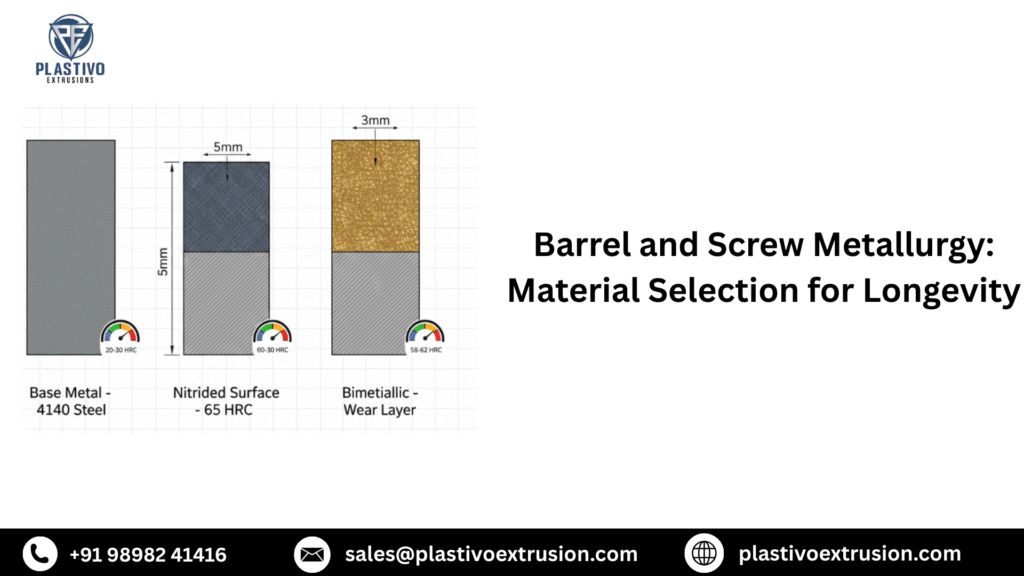
Barrel and Screw Metallurgy: Material Selection for Longevity

Ahmedabad, Gujarat GST No.-24AAVHA8297E1ZU +91 98982 41416 Linkedin-in Instagram Whatsapp Home About us ☰ Our Product Auxiliary Equipment Extruders Pipe Making Machine Plastic Recycling Machine Screw Barrel Blogs Contact us Home About us ☰ Our Product Auxiliary Equipment Extruders Pipe Making Machine Plastic Recycling Machine Screw Barrel Blogs Contact us Request Appointment Barrel and Screw Metallurgy: Material Selection for Longevity The Foundation of Extruder Durability Material selection for extruder barrels and screws represents a critical decision that impacts operational life, maintenance costs, and processing capabilities. The extreme conditions inside extruders—high temperatures, corrosive chemicals, and abrasive fillers—demand materials engineered to withstand prolonged exposure without excessive wear or failure. Base Metal Selection for Screws The most common base material for extruder screws is AISI 4140 alloy steel, offering an excellent balance of strength, toughness, and cost-effectiveness. This chromium-molybdenum steel provides good hardenability, allowing effective heat treatment throughout the screw’s cross-section. After hardening and tempering, 4140 achieves core hardness levels of 28 to 32 Rockwell C, adequate for many standard applications. For more demanding applications, AISI 4340 steel provides enhanced toughness and fatigue resistance. The nickel content in 4340 improves impact strength, making it suitable for screws operating under high torque or variable loading conditions. This material costs approximately 20 to 30 percent more than 4140 but delivers superior performance in challenging environments. Stainless steel screws, typically manufactured from 17-4PH or similar precipitation-hardening alloys, serve applications involving corrosive materials or strict contamination requirements. The pharmaceutical and food industries frequently specify stainless construction to meet regulatory standards. While offering excellent corrosion resistance, stainless steels generally provide lower wear resistance than carbon steels unless specially treated. The base metal’s machinability influences manufacturing costs significantly. Materials that machine easily reduce production time and tooling costs, while harder alloys require specialized equipment and slower cutting speeds. Designers must balance material performance against manufacturing economics when specifying base metals. Surface Hardening Techniques Even the best base metals require surface hardening to achieve acceptable wear resistance. Nitriding represents the most widely used surface treatment for extruder screws, diffusing nitrogen into the steel surface to create an extremely hard case. Gas nitriding typically produces case depths of 0.015 to 0.030 inches with surface hardness exceeding 65 Rockwell C. The nitriding process occurs at relatively low temperatures, typically 950 to 1050 degrees Fahrenheit, minimizing dimensional distortion. This characteristic makes nitriding ideal for finished screws where maintaining tight tolerances is essential. The nitrogen case also provides excellent corrosion resistance, protecting the underlying steel from chemical attack. Ion nitriding, also called plasma nitriding, offers enhanced control over the nitriding process. This technique uses an electrical field to accelerate nitrogen ions toward the screw surface, enabling precise control of case depth and hardness profile. Ion nitriding produces less distortion than gas nitriding and can selectively treat specific areas while masking others. Carburizing introduces carbon into the steel surface, creating a hard case with a tough core. This process requires higher temperatures than nitriding, typically 1650 to 1750 degrees Fahrenheit, followed by quenching and tempering. Carburizing produces deeper cases than nitriding, often 0.040 to 0.120 inches, beneficial for applications involving heavy wear. Induction hardening uses electromagnetic induction to rapidly heat the screw surface, followed by immediate quenching. This technique produces very hard surfaces, typically 58 to 62 Rockwell C, with minimal distortion. Induction hardening works particularly well for large-diameter screws where through-hardening would be impractical. Bimetallic Barrel Construction Bimetallic barrels combine two different materials to optimize performance and cost. The inner liner, in direct contact with processed material, uses a wear-resistant alloy, while the outer shell employs standard carbon steel for structural support. This construction provides superior wear resistance at lower cost than manufacturing the entire barrel from premium alloy. The liner material typically consists of high-chromium iron or specialized nickel alloys, offering exceptional hardness and corrosion resistance. Centrifugal casting bonds the liner to the outer shell, creating a metallurgical connection that ensures heat transfer and mechanical integrity. Liner thickness generally ranges from 0.125 to 0.375 inches, balancing wear life against heat transfer requirements. Bimetallic barrels excel in applications processing abrasive compounds containing glass fibers, mineral fillers, or flame retardants. The wear resistance of premium liner materials extends barrel life by factors of three to five compared to standard construction. While initial costs run 40 to 60 percent higher than conventional barrels, the extended service life often provides excellent return on investment. Advanced Coating Technologies Tungsten carbide coatings represent the pinnacle of wear protection for extruder components. Applied through thermal spray processes, these coatings create surfaces with hardness exceeding 70 Rockwell C. The coating consists of tungsten carbide particles suspended in a metallic matrix, typically cobalt or nickel. Several thermal spray processes apply tungsten carbide coatings. High-velocity oxygen fuel spraying produces dense, well-bonded coatings suitable for most applications. Plasma spraying achieves even higher coating densities but requires more sophisticated equipment. Detonation gun spraying generates the hardest, most wear-resistant coatings but involves higher processing costs. Coating thickness typically ranges from 0.010 to 0.030 inches, providing substantial wear protection without excessive buildup that might require extensive machining. Post-coating grinding returns surfaces to precise dimensions, ensuring proper fit within barrel bores or between intermeshing screw elements. Ceramic coatings offer alternatives to carbide for specific applications. Chromium oxide coatings provide excellent wear resistance with superior corrosion protection, ideal for processing corrosive chemicals. Aluminum oxide coatings offer good wear resistance at lower cost than carbide, suitable for moderately abrasive applications. Diamond-like carbon coatings represent emerging technology for extruder applications. These coatings exhibit extremely low friction coefficients along with good wear resistance, potentially reducing drive power requirements while extending component life. However, their relatively high cost currently limits adoption to specialized applications. Corrosion Resistance Considerations Many polymers generate corrosive byproducts during processing, particularly when overheated or contaminated with moisture. Polyvinyl chloride releases hydrochloric acid when degraded, rapidly attacking standard steel surfaces. Flame-retardant additives often contain halogens that similarly corrode metal components. Corrosion-resistant materials combat these challenges. Stainless steel screws and barrels eliminate corrosion concerns but may require special surface treatments to achieve

Barrel and Screw Metallurgy: Material Selection for Longevity Read More »

Parallel Twin Screw Barrel A Comprehensive Guide to Modern Processing Technology (1) - Plastivo Extrusions

Thermal Management Systems in Extruder Barrels

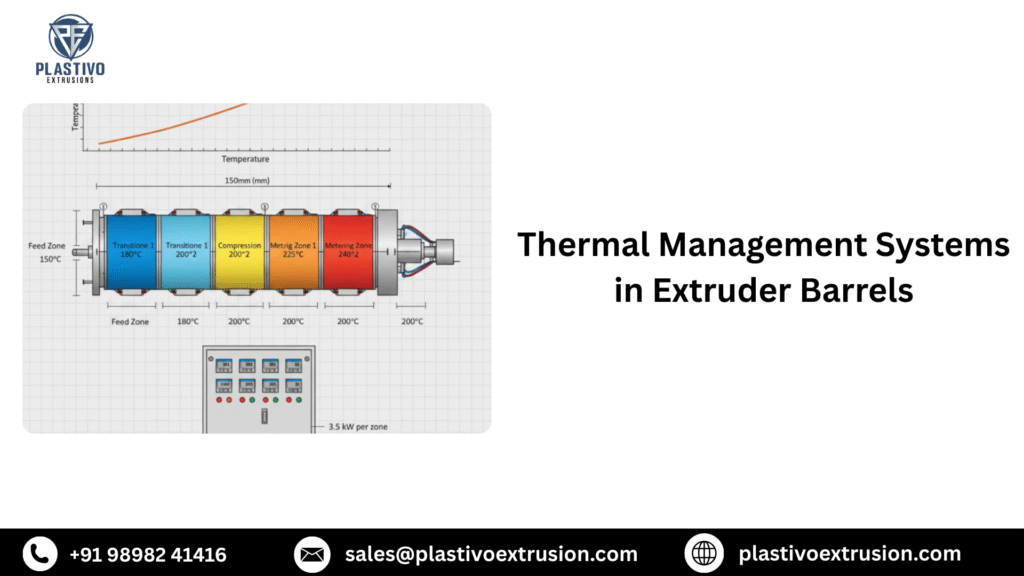
Ahmedabad, Gujarat GST No.-24AAVHA8297E1ZU +91 98982 41416 Linkedin-in Instagram Whatsapp Home About us ☰ Our Product Auxiliary Equipment Extruders Pipe Making Machine Plastic Recycling Machine Screw Barrel Blogs Contact us Home About us ☰ Our Product Auxiliary Equipment Extruders Pipe Making Machine Plastic Recycling Machine Screw Barrel Blogs Contact us Request Appointment Thermal Management Systems in Extruder Barrels The Critical Role of Temperature Control Temperature control in extruder barrels directly determines product quality, process stability, and production efficiency. Every polymer exhibits specific temperature requirements for optimal processing, with deviations causing defects ranging from subtle appearance issues to complete product failure. Understanding thermal management systems enables processors to maintain the precise conditions necessary for consistent, high-quality output. Fundamentals of Heat Transfer in Extrusion Extrusion involves complex heat transfer mechanisms operating simultaneously. Conduction transfers heat from barrel heaters through the barrel wall to polymer at the barrel surface. This heat must then conduct through the polymer itself, a notoriously poor thermal conductor, to reach material in screw channels. Convection occurs as screw rotation circulates molten polymer, distributing heat throughout the material. The effectiveness of convective mixing depends on screw design, rotational speed, and polymer viscosity. Highly viscous materials resist mixing, creating temperature gradients within melt streams. Viscous dissipation generates heat through molecular friction as screws shear polymer chains. This internal heat generation can significantly exceed external heating, particularly at high screw speeds or with viscous materials. Balancing viscous heating with external temperature control represents a primary challenge in extrusion process management. Electric Band Heaters Electric band heaters remain the most common heating method for extruder barrels. These devices clamp around the barrel exterior, using resistance heating elements to generate thermal energy. Mica or ceramic insulation protects the metal housing while directing heat toward the barrel. Standard band heaters employ coiled wire heating elements embedded in ceramic or mica matrices. These durable designs withstand repeated thermal cycling and provide reliable service for years. Power densities typically range from 5 to 8 watts per square inch of barrel surface, adequate for most applications. Higher-performance band heaters use ribbon or etched foil elements that distribute more uniformly across the heating surface. These designs reduce hot spots and improve temperature uniformity, beneficial for temperature-sensitive materials. Power densities can reach 12 watts per square inch, enabling faster heat-up times and better response to process disturbances. The thermal mass of band heaters affects their response characteristics. Lightweight designs respond quickly to temperature controller commands but may create temperature oscillations. Heavier heaters respond more slowly but provide stabler control, particularly at low screw speeds where viscous heating varies significantly. Proper band heater installation critically impacts performance. Heaters must fit tightly against barrel surfaces to ensure good thermal contact. Air gaps created by loose fitting or accumulated debris significantly reduce heat transfer efficiency, forcing heaters to operate at higher temperatures that accelerate failure. Cast-In Heaters Cast-in heaters integrate directly into barrel construction, embedded within the barrel wall during manufacturing. This intimate thermal contact provides superior heat transfer efficiency compared to external band heaters. The embedded design also protects heating elements from mechanical damage and contamination. Tubular heating elements follow grooves machined into the barrel exterior before being covered with cast metal. The casting process creates excellent thermal bonds, virtually eliminating air gaps that reduce heat transfer. Power densities comparable to band heaters provide adequate heating capacity. Cartridge heaters insert into drilled holes, offering easier replacement than tubular elements. Multiple cartridges distribute heating across each barrel zone, with individual element failure causing reduced capacity rather than complete zone loss. This redundancy improves system reliability in critical applications. The primary disadvantage of cast-in heaters involves replacement difficulty. Failed elements require machining operations to remove old heaters and install replacements, potentially necessitating complete barrel removal from the extruder. However, the superior reliability of cast-in designs often means they outlast multiple sets of band heaters. Induction Heating Systems Induction heating represents advanced technology offering rapid response and precise control. An electromagnetic coil surrounding the barrel generates a high-frequency alternating magnetic field. This field induces electrical currents in the conductive barrel wall, generating heat directly within the metal. The primary advantage of induction heating lies in its extremely fast response time. Traditional heaters require time for thermal energy to conduct through heater bodies before reaching barrels. Induction heating eliminates this delay, generating heat directly where needed. Response times measured in seconds rather than minutes enable precise temperature control even during rapid process changes. Energy efficiency represents another significant benefit. Induction systems convert electrical energy to heat with minimal losses, typically exceeding 90 percent efficiency. Conventional heaters lose substantial energy to surrounding air, particularly in drafty production environments. The rapid heating capability also reduces energy consumption during start-up procedures. The high equipment costs of induction systems currently limit their adoption primarily to specialized applications requiring superior performance. However, for processes involving frequent grade changes, temperature-sensitive materials, or demanding quality requirements, induction heating delivers advantages justifying the investment. Liquid Cooling Systems Cooling capacity often limits processing speeds more than heating capacity. Polymer entering the extruder at room temperature may require heating, but the majority of heat input comes from viscous dissipation. Excessive temperatures cause degradation, discoloration, or dimensional instability, making effective cooling essential. Water cooling provides the most common cooling method, circulating through passages drilled in barrel walls. Cold water enters at one end of each cooling zone, absorbs heat while flowing through internal passages, and exits at elevated temperature. Flow rates typically range from 1 to 5 gallons per minute per zone, depending on barrel size and cooling requirements. Inlet water temperature significantly affects cooling capacity. Colder water removes more heat, but excessively cold water may cause rapid temperature fluctuations that destabilize processes. Most operations maintain water temperatures between 50 and 70 degrees Fahrenheit, balancing cooling capacity against control stability. Oil cooling systems serve applications requiring temperatures above water’s boiling point or needing more precise control. Temperature-controlled oil circulates through barrel cooling passages, providing both heating and cooling from a single system. The higher heat capacity and

Thermal Management Systems in Extruder Barrels Read More »