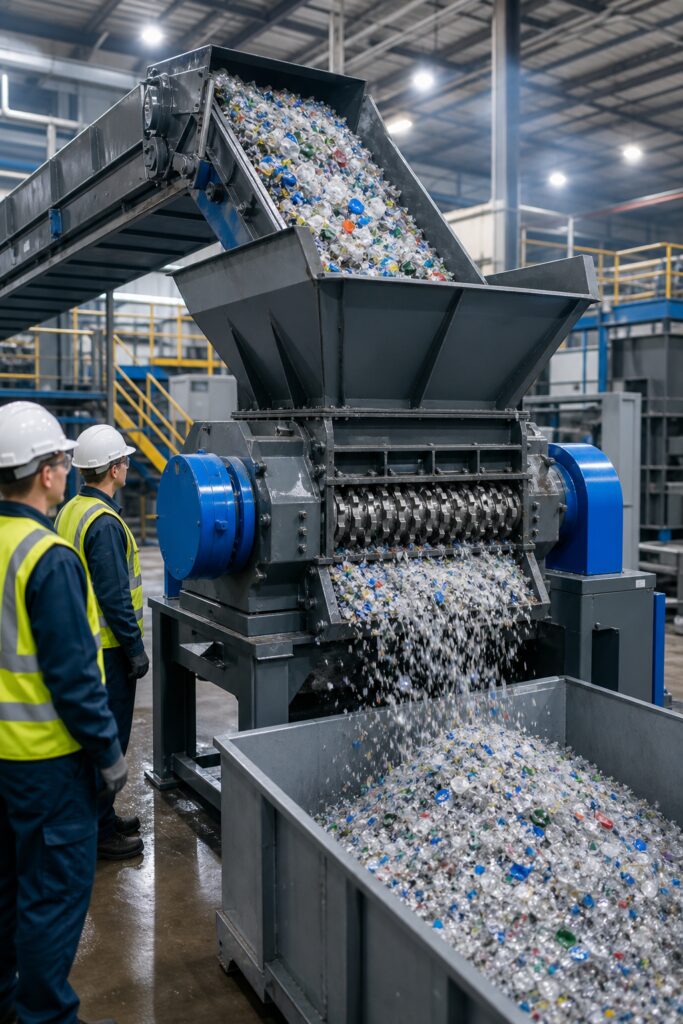
Deciding on a plastic shredder machine price is harder than it looks. Most manufacturers publish zero capacity figures and zero power ratings online, so you’re forced to compare machines on marketing claims alone. This guide cuts through that by explaining what actually drives cost, what specs matter, and how to evaluate total value before you commit.
Types of Plastic Shredder Machines and Where Each Fits
The mechanical architecture of a shredder is the first cost driver. Three basic configurations exist, and each one targets a different material and throughput requirement.
Single-shaft shredders use one rotor with fixed or swing blades cutting against a stationary bed knife. They’re designed for clean, sorted plastic such as PET bottles or HDPE pipe offcuts. Output particle size is controlled by a bottom screen. These machines are common in India and across Nigeria, Kenya, and Ghana where sorted post-consumer PET feeds downstream extruder or pelletizer lines.
Twin-shaft and dual-shaft shredders run two counter-rotating shafts. The difference between twin and dual is mostly terminology , twin-shaft usually refers to low-speed, high-torque designs that tear through mixed or contaminated material. These are the right choice when you’re processing unsorted municipal plastic waste, baled HDPE, or mixed film with PP woven sacks layered together.
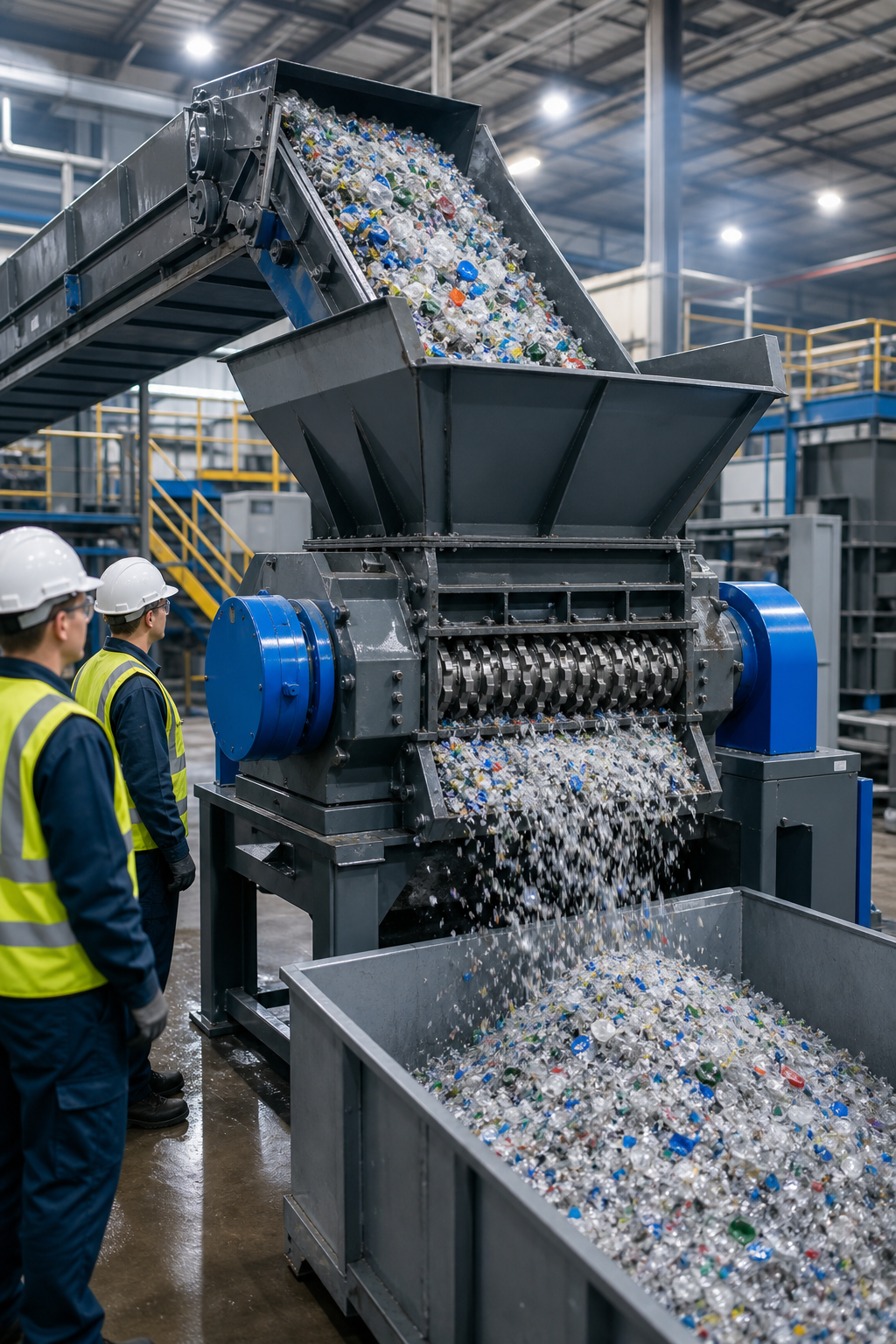
Micro and lab-scale shredders represent a third category. These handle 3D printing waste, film offcuts in small workshops, or material sampling in R&D environments. They’re not production machines , output is measured in kilograms per hour rather than hundreds of kilograms , but their upfront cost is far lower.
The shaft configuration affects price directly. A single-shaft machine with a 15 kW motor and 200 kg/hr rated output costs less than a twin-shaft unit with 37 kW and comparable throughput, because the twin-shaft requires more precision machining on the rotor assembly and more strong gearbox design. Rotor blade geometry and tip speed are the primary engineering variables that determine both output size and energy draw.
Where each type fits operationally: single-shaft suits recycling plants in Tamil Nadu or Kerala running clean PET or HDPE; twin-shaft suits mixed-waste processors in Lagos or Nairobi where contamination levels are high; micro-shredders suit UAE-based prototyping studios or plastic compounding R&D labs.
Key Specifications That Drive Plastic Shredder Machine Price
When a vendor’s website shows no capacity or power data , which happens across most publicly listed shredder models , you have to know which specifications to request directly. These are the numbers that determine whether a machine is priced fairly.
Motor power (kW). This is the single most honest indicator of a machine’s capability. A 7.5 kW motor won’t push hard plastic like thick-walled HDPE pipe scrap through efficiently. For serious recycling volumes in India or Africa, look at a minimum of 15 kW for entry-level production. Heavy industrial machines run 37 kW to 75 kW or more. Higher motor power means higher machine price , and higher electricity cost per shift.
Throughput (kg/hr). Rated throughput is often stated as a peak figure under ideal conditions. Always ask for output on your specific material. PET bottles shred faster than thick HDPE lumps. A machine rated at 500 kg/hr on PET film might produce 150 kg/hr on mixed rigid plastic. This gap between rated and real output is where ROI calculations break down for buyers who don’t push vendors for material-specific data.
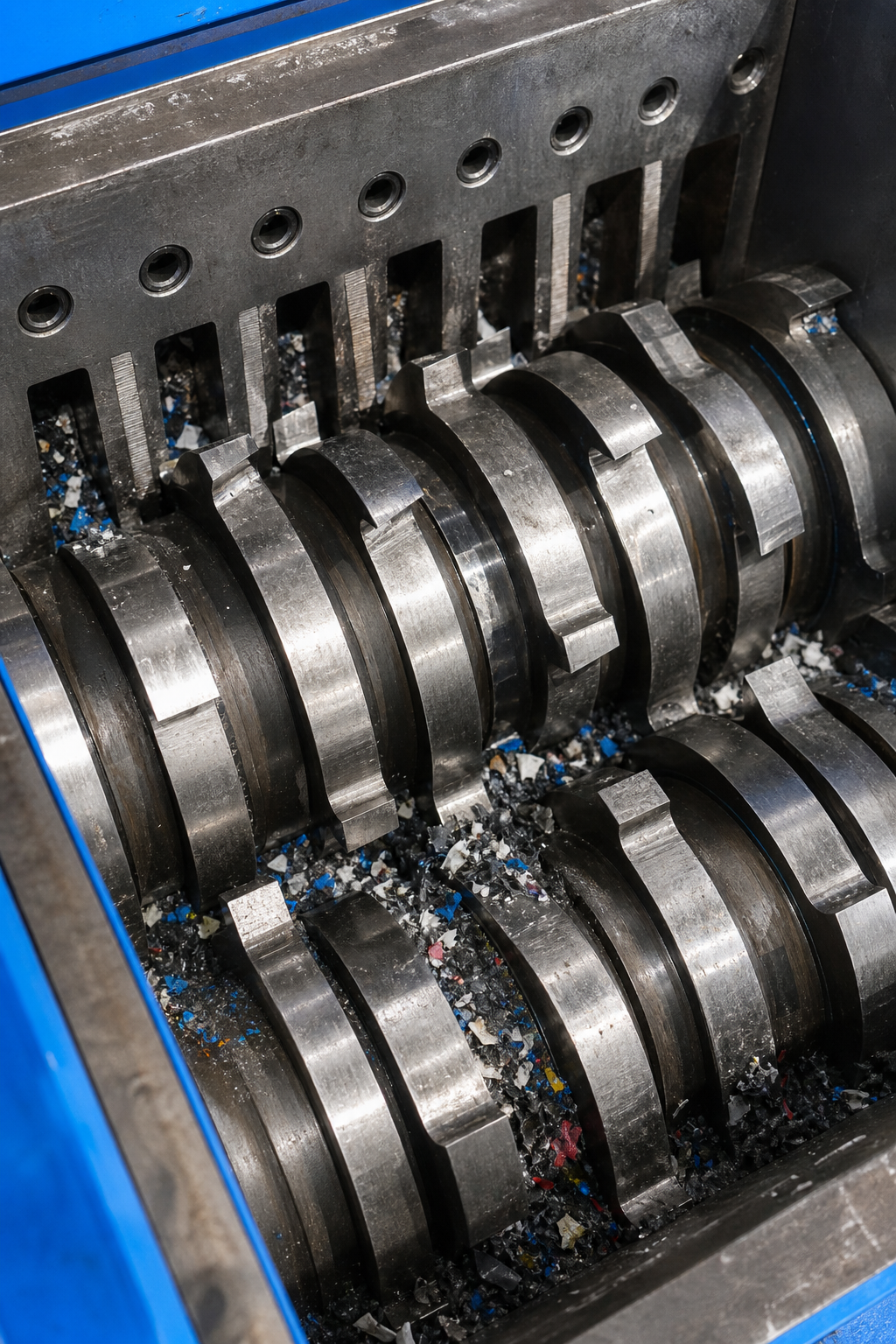
Blade material and configuration. Blades made from D2 tool steel or similar high-chromium alloys last significantly longer than mild steel variants when processing abrasive materials. More blades on the rotor mean finer output but more frequent sharpening. Blade replacement is a recurring cost, so the hardness rating (often expressed as HRC) matters as much as the initial blade count.
Screen size. The bottom screen controls output particle size. Smaller screen apertures mean finer flakes , which downstream extruders and plastic granules making machines prefer , but they also reduce throughput and increase energy consumption per kilogram. This trade-off directly affects per-ton processing cost.
Hopper dimensions and feed type. A wide hopper with a hydraulic pusher handles larger pieces without manual pre-cutting. Narrower gravity-fed hoppers require more labor to size material before feeding. Labor cost is real operating cost, even if it doesn’t appear on the machine’s price tag.
Pricing varies considerably across the range — from small lab-scale units to full industrial lines — and exact figures depend on motor power, throughput, and configuration. Contact suppliers directly for model-specific quotes based on your material and output requirements.
Rotor speed (RPM) is another spec worth noting. Low-speed high-torque designs (typically 30, 80 RPM) are quieter and generate less heat, which matters for film plastics that melt at low temperatures. High-speed designs (200, 500 RPM) suit brittle plastics like PS or PET but produce more noise and fines.
Plastic Shredder Machine Price Ranges by Category
Quoted prices for shredders vary enormously depending on origin, specification, and supplier relationship. The table below reflects reference ranges drawn from manufacturer catalogs. These are reference ranges , your actual landed cost will differ based on shipping, import duties (relevant for buyers in Nigeria, South Africa, or UAE importing from India or China), installation, and commissioning.
Pricing across machine classes varies widely even within the same capacity bracket. Chinese-supplied dual-shaft units and full material-specific shredder lines illustrate how significantly configuration, origin, and application can shift the final number. These differences reinforce why comparing machines on power and throughput alone is insufficient.
One consistent pattern across the market: no publicly listed model shows capacity and power figures alongside price in a single listing. This is deliberate. Manufacturers want you to inquire, so they can qualify your application and adjust pricing accordingly. At Plastivo Extrusions, we take a different approach , when you reach out, we discuss your material, your output target, and your facility layout before quoting, so the number you receive reflects your actual requirement.
Import duty matters for buyers outside India. A buyer in Lagos or Accra importing a $10,000 shredder from Gujarat will add freight, port charges, and import duty that can push landed cost 25, 40% higher. Factor that into any price comparison between Indian-manufactured and Chinese-manufactured machines.
For buyers setting up a full recycling line , shredder feeding a washing section and then a pelletizer , the shredder is typically 20, 30% of total line cost. The downstream equipment, especially the extruder and die head, often costs more. Planning the full line budget from the start avoids the common mistake of buying an undersized shredder and then discovering it’s the bottleneck on a higher-capacity pelletizer.
Total Cost of Ownership: Beyond the Machine Price Tag
The machine price is the number you negotiate. Total cost of ownership is the number that decides whether the investment works. For plastic shredders, TCO has four main components beyond the sticker price.
Energy consumption. A 37 kW shredder running two shifts daily (16 hours) at ₹8 per kWh in India draws significant electricity costs. A more efficient machine that draws 30 kW for the same throughput produces meaningful annual savings on power. That gap often exceeds the price difference between a budget machine and a well-engineered one.
Blade replacement and sharpening. Blades on a mid-range shredder typically need sharpening every 200–400 operating hours depending on material. Blade set costs vary depending on steel grade and rotor size. Buying a machine with proprietary blade geometry from a distant supplier creates a long-term parts dependency problem. This is a real risk for buyers in East Africa or Southeast Asia purchasing from manufacturers with no local service network.
Reliable plant operation also depends on infrastructure. A recycling facility running multiple machines needs stable power supply, proper ventilation, and in some climates, temperature-controlled working conditions. Operators managing facilities in humid coastal regions of South Asia or West Africa often factor in HVAC system maintenance as part of keeping machinery running within safe operating temperature ranges.
Maintenance intervals and downtime cost. Gearbox oil changes, bearing inspections, and belt replacements are scheduled costs. Unscheduled downtime — a jammed rotor, a burnt motor, a cracked screen — is the expensive kind. A machine that’s down for a week while waiting for a spare part from overseas costs you in lost processing revenue. Ask vendors specifically: what is the average MTBF (mean time between failures) for the gearbox and rotor bearings?
Labor requirements. A gravity-fed shredder with no hydraulic pusher requires workers to pre-size material and feed it manually. A machine with an automated conveyor feed and a hydraulic ram reduces labor input significantly. The cost of two extra workers over a year can exceed the price premium of a better-specified machine.
ROI and Profit Potential for Different Business Models
The profit case for a plastic shredder depends entirely on what happens to the shredded output. There are three business models worth understanding.
Selling shredded flakes directly. Clean PET flakes sell at prices that vary by market and grade — contact local recyclers or commodity traders for current rates. Processing 500 kg per day can generate meaningful daily revenue from material alone, assuming free or near-free input stock. That covers operating costs at the entry level but leaves thin margins. This model works best when you have a reliable free or very low-cost waste stream , from a factory, collection program, or municipal contract.
Shredding as the first stage in a full recycling line. When the shredder feeds a washing unit and then a pelletizer or extruder, output value jumps. Clean recycled HDPE or PET pellets command significantly higher per-kg prices than raw flakes — typically two to four times the value, depending on grade and market. At Plastivo Extrusions, we design shredder and plastic recycling machine configurations specifically for this integrated model , where the shredder throughput matches the extruder’s feed requirement, so neither machine is the constraint.
Understanding the full process from shredding through to pelletizing is worth reviewing before you commit to equipment. The plastic granules making process involves more steps than many first-time buyers anticipate, and sizing each step correctly determines whether the overall line is profitable.
Contract shredding as a service. Some operators don’t buy the material at all , they charge a tipping fee to factories, retailers, or municipalities to accept and shred their plastic waste. In markets like UAE, South Africa, or urban India, gate fees of ₹3, ₹8 per kg are achievable for certain industrial plastics. This model turns the shredder into a fee-for-service asset with predictable utilization if you can secure volume contracts.
Payback periods vary widely depending on machine capacity, daily throughput, and net margin per kg processed. A higher-capacity industrial unit with strong daily net margins can achieve payback faster when throughput is fully utilized. The higher-end machine often has the shorter payback when throughput is fully used , but utilization is the key assumption. A machine sitting idle 40% of the time because your supply chain isn’t organized changes all the numbers.
Safety, Compliance, and Operational Considerations
Running a shredder without proper safety systems is a liability, not just a regulatory concern. Rotating machinery at low speed but high torque can cause serious injury if access panels are not interlocked. Any machine you buy should have emergency stop buttons within reach of the operator at all feed points, and the hopper access should not be possible to open while the rotor is turning.
Electrical safety matters especially in markets where power supply is inconsistent. Motors should have thermal overload protection built in. Machines without this protection burn out motors on voltage fluctuations , a common issue in West Africa and parts of South Asia.
Noise is an underestimated compliance issue. High-speed shredders can exceed 90 dB(A) at the operator position, which requires hearing protection and noise exposure limits per shift. Low-speed twin-shaft designs typically run 15, 25 dB quieter than equivalent single-shaft high-speed machines. If your plant is in a residential area or a shared industrial complex, the noise profile of the machine matters for your operating license.
Dust and fine particle generation is the other compliance factor. Shredding dry rigid plastics , especially brittle materials like PS or ABS , generates airborne fines. A proper collection hood with a bag filter above the shredder discharge keeps the workspace compliant and also recovers material that would otherwise be lost.
For operations in India, the Plastic Waste Management Rules govern collection and processing obligations. Plants in Gujarat, Tamil Nadu, and Maharashtra are subject to state pollution control board inspections. Verify that the machine you buy meets your local regulatory requirements for noise, dust, and effluent, not just the price point.
Financing, Warranty, and After-Sales Support: What to Demand
A shredder purchase is a capital equipment decision. Very few buyers pay cash for a $20,000+ machine, and even for smaller units, financing terms affect the real cost significantly.
In India, MSME-targeted equipment finance schemes from nationalized banks often cover plastic processing machinery at 10, 14% annual interest over 3, 5 years. In East Africa and the Gulf, equipment leasing through local finance companies is an option, though rates are higher. Some Indian machinery manufacturers, including Plastivo Extrusions, can provide documentation support to help buyers access institutional finance or equipment loans.
Warranty terms are not standardized. A one-year warranty on parts is common. But what matters more than the warranty period is what the warranty actually covers , and who pays for shipping if a component needs to be replaced. A “one-year warranty” from a Chinese manufacturer delivering to Kenya that excludes shipping costs for warranty claims is effectively no warranty at all for a heavy gearbox component.
After-sales support is the differentiator that buyers regret ignoring. Ask these questions before signing any purchase order:
- Where is the nearest service engineer? What is the typical response time?
- Are spare blades and wear parts stocked in-country or only available on order?
- Is commissioning included in the price, or is it a separate line item?
- Does the vendor provide operator training, and in what language?
Plastivo Extrusions supplies machines across India and exports to Nigeria, Kenya, Ghana, Ethiopia, UAE, and Southeast Asia. We include commissioning support and provide training for plant operators as part of the delivery, because a machine that’s set up incorrectly from day one never performs to its rated specification. Precision engineering means nothing if the installation is rushed.
FAQ
How much does a plastic shredder machine cost?
A plastic shredder machine price varies widely depending on scale and configuration. Entry-level single-shaft machines for clean PET or HDPE typically cost $2,000–$6,000. Mid-range industrial shredders run $8,000–$35,000. The final price depends on motor power, throughput, blade material, shaft configuration, and whether commissioning is included.
What specifications should I compare when buying a plastic shredder?
Focus on motor power in kW, rated throughput in kg/hr for your specific material, blade steel grade (HRC hardness), screen aperture size, and rotor speed in RPM. Also ask about gearbox type and expected service interval. Vendors who won’t provide these numbers on your material type are telling you something , either the spec doesn’t match your needs or the data doesn’t exist.
Is a twin-shaft shredder better than a single-shaft shredder?
Not better in all situations , just different. Twin-shaft shredders handle mixed, bulky, or contaminated plastic without jamming and run at lower RPM with higher torque. Single-shaft machines produce more consistent output particle size and suit clean, sorted material. The right choice depends on your input stream. For mixed municipal plastic, twin-shaft wins. For clean PET bottle bales, a single-shaft is often more cost-efficient.
What is the total cost of owning a plastic shredder?
Beyond the machine price, budget for electricity (a 37 kW unit running two shifts draws significant power costs in India), blade replacement or sharpening every 200–400 hours, gearbox maintenance, and labor. Unscheduled downtime from parts unavailability is the largest hidden cost for buyers who source from distant suppliers with no local spare parts inventory.
Can a small plastic shredder be profitable?
Yes, if your input stream is free or very low cost and your output has a ready buyer. Processing clean PET and selling flakes generates daily revenue that varies by local market rates. Net margin depends on electricity and labor costs in your location. Profitability improves significantly when the shredder feeds downstream equipment like a pelletizer, because granulated pellets sell for two to four times the price of raw flakes.
How do I evaluate after-sales support from a shredder supplier?
Ask the supplier where their nearest service engineer is located, what the typical response time is for a machine fault, and whether spare blades and wear parts are stocked locally or ordered on demand. Request contact details for two existing customers running the same machine in a similar application. A supplier confident in their after-sales support will provide references without hesitation.
What to Do Next
The plastic shredder machine price you see online is just a starting point. What you actually need to evaluate is motor power for your material, real throughput under your operating conditions, blade life, and whether the supplier can support you after delivery. At Plastivo Extrusions, we work with plant owners across India, Nigeria, Kenya, and the UAE to specify shredders that fit both the application and the budget , and we back that with commissioning support and spare parts availability. Get in touch with your material type and daily volume target, and we’ll give you a number that means something.