
Pelletizing machine price is one of the most searched terms in plastic machinery procurement, yet most suppliers won’t publish a number. That’s not evasion , it’s because the price genuinely depends on what you’re processing, how much output you need, and which cutting system fits your line. This guide breaks down what drives the cost and what you can realistically expect to pay.
What Drives Pelletizing Machine Price

The single biggest misconception buyers bring to the table is that pelletizer pricing works like buying a lathe or a conveyor belt. It doesn’t. A pelletizer is a system, and every component choice compounds into the final cost.
Start with the extruder itself. A single-screw machine is mechanically simpler and costs less to manufacture and maintain. A twin-screw machine costs more because the gearbox is more complex, the screw elements wear faster, and the barrel requires tighter tolerances. But for materials like PET or highly contaminated post-consumer film, a twin-screw extruder often pays back the price difference within months because it handles devolatilization more effectively and needs less pre-drying preparation.
The screw and barrel specification matters more than most buyers realize. Processing recycled plastics that contain sand, residual adhesive, or glass fiber reinforcement? Standard nitrided steel wears out fast. Bimetallic barrels with tungsten carbide alloy lining last significantly longer than nitrided steel under those conditions. That upgrade adds cost upfront, but the math usually favors it over a two-year horizon.
The cutting system is another lever. Strand pelletizing has the lowest capital cost and suits most engineering plastics and recycling applications at moderate throughputs. Water ring systems sit in the mid-range. Underwater pelletizing (UWP) systems produce the most uniform spherical pellets and handle high outputs well, but their initial investment is significantly higher and the closed-loop water management adds operational complexity.
Filtration is a frequently underestimated line item. A dual-station continuous screen changer, now standard on most production lines, adds meaningfully to the module cost alone. Add a vacuum degassing section, a PLC touchscreen control system, or an automatic strand take-up system, and the base price climbs fast.
At Plastivo Extrusions, we engineer screw barrels and pelletizing systems for exactly these trade-offs. Our plastic strand pelletizer machine is designed for stable output on HDPE, LDPE, and PP streams, with barrel specifications matched to the actual abrasion profile of your feedstock.
Pelletizing Machine Price Ranges by Type
Published price data for pelletizing machines is sparse and rarely includes output specs. Across the machines we tracked in our research, disclosed starting prices ranged from entry-level hot-die air systems to over $200,000 for high-capacity strand pelletizing lines. No surveyed listing included output capacity in kg/hr or power consumption in kW alongside the price, which makes comparison shopping based on listed prices alone nearly impossible.
Here’s how the main system types actually stack up in practice:
The overlap between system types is wide. A water ring system and a strand pelletizer at the same price point are not equivalent machines — the strand unit at that price likely has higher throughput and a more capable screw L/D ratio. Price without specs is a weak comparison point.
For buyers in India, the domestic market adds another variable: machines priced in INR from Ahmedabad-based suppliers are available for 65 kW recycling pelletizers, with rates available on request. These are typically single-screw units with helical gearboxes and alloy steel screw barrels, suited for HDPE, PP, LDPE, and PVC at 100–200 kg/hr output. They’re a workable entry point for a small recycling operation, but won’t handle PET or highly contaminated mixed-plastic waste without modification.
Plastivo Extrusions does not publish a fixed price list. That reflects how we actually work: machine specifications are matched to your material stream, output target, and site conditions before any number is quoted. For buyers in Kenya, Nigeria, or the UAE, that approach matters because local power specs, ambient temperature, and available operator skill all affect the right machine configuration.
How Output Capacity and Specs Affect Cost
Output capacity is the most direct driver of machine cost. A pelletizer rated at 150 kg/hr and one rated at 800 kg/hr are not variations of the same machine , they involve different screw diameters, motor power ratings, gearbox sizes, and die head configurations. Each step up in throughput means a heavier machine, a larger footprint, and a higher price.
A standalone pelletizer for a small recycling operation at 100–200 kg/hr carries pricing that varies by configuration and supplier for most material types. Move up to 300–500 kg/hr and the pelletizer alone — not counting the upstream washing or shredding equipment — sits at a significantly higher price point. Industrial lines processing 500–1,000 kg/hr for a production-ready system represent a further step up; pricing is available on request from suppliers based on final specifications.
Motor power (kW) and screw diameter are the most reliable specs for understanding where a machine sits in that range. A 65 kW unit with a 130mm screw diameter is a different proposition from a 90 kW unit with a 150mm screw and a 30:1 L/D ratio. The longer screw delivers more residence time, better melt homogeneity, and more effective degassing , all of which matter when your feedstock is post-consumer film with residual moisture and ink contamination.
Automation level is the other major cost lever. A basic PLC with fixed temperature zones costs far less than a full touchscreen control system with remote monitoring, automated screen changer, and servo-driven cutter speed. Those features add meaningfully to the base cost but reduce labour dependency and keep output consistent across shifts. For a plant running two or three shifts in Tamil Nadu or Kerala, that trade-off often makes sense.
Our high-efficiency pelletizing system for HDPE, LDPE, LLDPE, and PP recycling addresses exactly this capacity-to-automation balance, with configurations sized from small-scale recyclers up to mid-capacity production lines.
Plastic Type and Material Compatibility Costs
Different plastics require genuinely different machine configurations, and those differences translate directly into price. This is not a subtle adjustment — the gap between a basic and a more complex pelletizer configuration can be substantial depending on plastic type and throughput requirements.
HDPE and PP are the most forgiving materials. They process well on single-screw extruders with standard nitrided barrels, and strand pelletizing works reliably at throughputs up to 400, 500 kg/hr. A machine for HDPE rigid flakes at 200 kg/hr is one of the more affordable configurations available.
LDPE and LLDPE film are harder. Low-bulk-density material (typically 0.1, 0.2 g/cm³ before densification) causes feeding problems in standard hoppers. You need either an integrated compactor/cutter chamber or a forced feeder system to get consistent output. That upstream addition adds cost. The good news: after pelletizing, bulk density reaches 0.4, 0.7 g/cm³, which makes the material much easier to handle and transport.
PET is the most demanding common recycling material. It’s hygroscopic — polyethylene terephthalate absorbs moisture rapidly and requires drying to below 50 ppm before extrusion to prevent hydrolytic degradation and intrinsic viscosity (IV) loss. A single-screw machine without vacuum degassing will degrade PET quality significantly. Twin-screw extruders with one or two vacuum venting sections handle this without pre-drying, but the machine cost is higher. PET pelletizing lines carry a significant cost premium for the pelletizing section alone, on top of a washing line that can add substantially more at 500 kg/hr.
PVC requires corrosion-resistant screw and barrel materials , typically a bimetallic Ni-Cr alloy grade, not standard nitrided steel , because chlorine off-gassing attacks the barrel bore over time. Failing to specify the right metallurgy when buying a PVC pelletizer means early wear and expensive barrel replacement. The initial premium on a corrosion-resistant barrel pays back fast on a PVC line.
Mixed plastics and post-consumer waste streams add contamination variables: glass, sand, metal fragments, residual adhesive. Here, bimetallic barrel technology is not optional , it’s the only viable choice for sustained production. A tungsten carbide bimetallic barrel (Grade A) lasts five to six times longer than standard nitrided steel under high-abrasion conditions. That longevity matters when you’re running two shifts recycling WEEE plastic or mixed agricultural film.
Buying New vs. Used Pelletizers: Cost Trade-offs
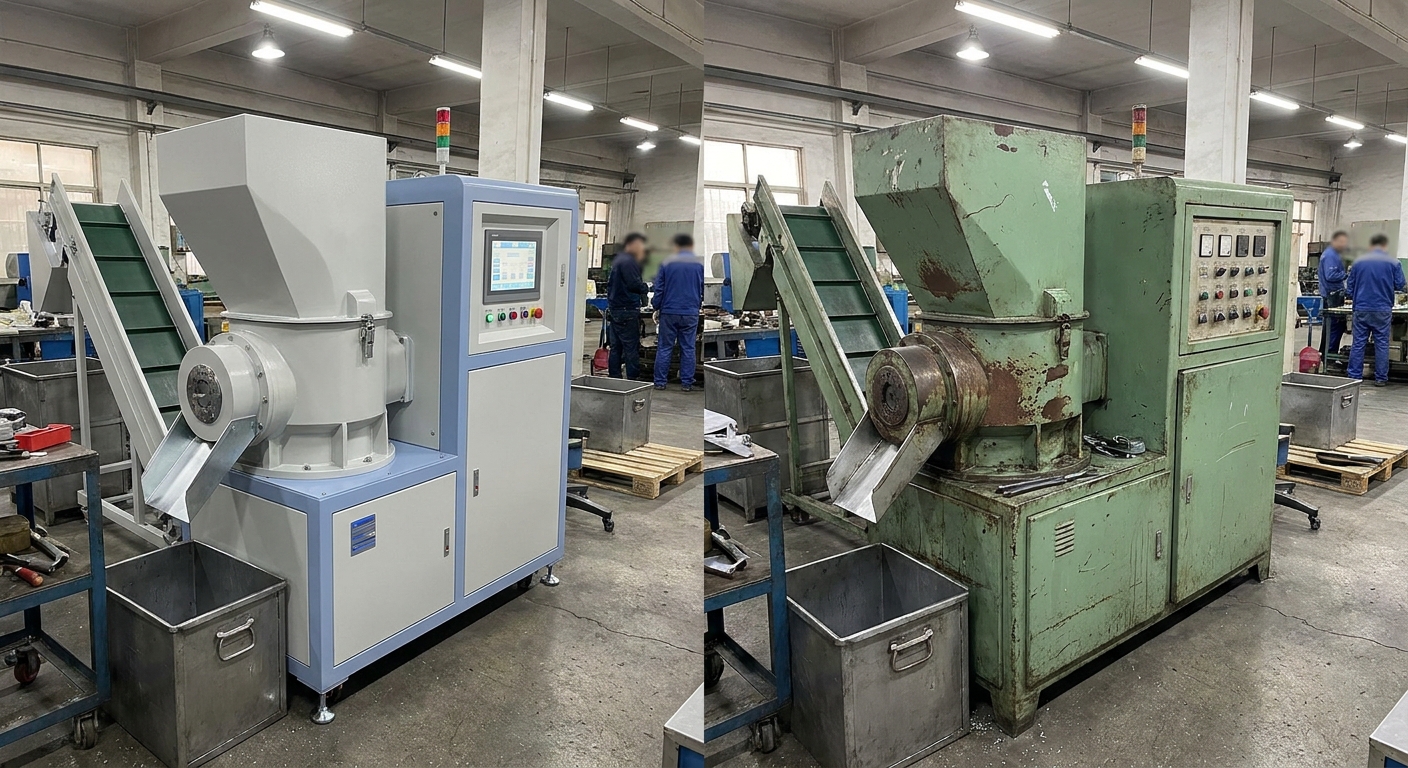
Used pelletizers can look attractive on paper. The gap between new and secondary market pricing is real. So is the risk that sits behind it.
The core problem with used pelletizing equipment is that the most expensive wear components , screw elements, barrel bore, die plate, cutter blades, and filter screens , are exactly what degrades in normal operation. You cannot evaluate their remaining service life from a photo or a factory visit without intrusive inspection. A machine that has processed abrasive filled compounds at high throughput may have a barrel bore worn beyond specification, which means inconsistent melt pressure, poor pellet quality, and frequent screen changer blockages from the moment you start it.
New equipment comes with a defined warranty period, a manufacturer-set screw and barrel specification, and commissioning support. When you buy a new pelletizer from a supplier like Plastivo Extrusions, the screw L/D ratio, barrel hardness, and barrel bore straightness are documented. You know what you’re getting. With used equipment, those specs are often unknown , and the previous owner rarely discloses them voluntarily.
There are legitimate scenarios where used makes sense. A plant that’s adding a second line for the same material it already processes well, with the operational knowledge to inspect the screw and barrel properly, can find real value on the secondary market. But for a first-time buyer in Nigeria or Ethiopia setting up a new recycling operation, a used machine with unknown history is a high-risk first asset. Downtime in year one of a startup operation is significantly more damaging than the upfront cost difference.
One angle buyers sometimes overlook: setting up a pelletizing line also means hiring and training operators. Building a qualified engineering and production team is a parallel investment worth planning alongside the machine purchase itself.
Pelletizer Pricing for Export Markets: India, Africa, UAE
India is the primary manufacturing hub for mid-range pelletizing machines exported to Africa, the UAE, and Southeast Asia. Gujarat, specifically the Vatva and Odhav industrial clusters in Ahmedabad, concentrates a large share of India’s plastic machinery production. That geography matters for pricing: FOB Mundra or JNPT freight costs to Mombasa, Lagos, or Dubai are predictable and lower than shipping from China or Europe.
For buyers in Kenya, Ghana, or Nigeria, an Indian-made pelletizer in a comparable price range typically arrives with better after-sales support than Chinese equipment at a similar price point, because Indian manufacturers can respond faster on spare parts and send engineers for commissioning without the logistical complexity of a trans-Pacific supply chain.
UAE buyers tend to specify higher automation levels. A line going into a Dubai or Sharjah recycling facility often needs full PLC control, CE or equivalent electrical safety compliance, and documentation packages for regulatory approval. That pushes the effective price up compared to a similar-capacity machine destined for a smaller African market. The machine hardware may be identical; the control system, wiring standard, and documentation package are not.
South African buyers face additional import duty considerations that can add to the landed cost. That makes the FOB price a poor comparison basis , total landed cost including freight, duty, and commissioning is the number that matters for ROI calculation.
Plastivo Extrusions supplies pelletizing and granulating machines across India and to export markets in Africa, the UAE, and South/Southeast Asia. We quote on a project basis, accounting for the material stream, required output, local power specifications, and whether the buyer needs commissioning support on-site. For anyone evaluating a plastic granules making machine from India, that tailored approach typically produces a better-specified machine at a more accurate price than any published list rate.
FAQ
How much does a pelletizing machine cost in India?
In India, a pelletizing machine for HDPE, LDPE, or PP recycling is priced based on output capacity, screw type, and automation level — contact suppliers directly for current figures. Small single-screw units at 100–200 kg/hr, mid-range machines for 300–500 kg/hr, and larger twin-screw or fully automated lines each fall into distinct pricing tiers. Price varies by screw type, barrel metallurgy, cutting system, and automation level.
What is the price difference between strand and underwater pelletizing systems?
Strand pelletizing is the lower-cost option with manageable maintenance requirements and pricing that scales with capacity. Underwater pelletizing systems start higher because the closed-loop water system, die heating, and automatic cutter assembly add significant complexity. For most recycling applications, strand or water ring systems offer better value.
What specs should I ask for alongside a pelletizer price quote?
Always request: screw diameter (mm), L/D ratio, barrel material (nitrided vs. bimetallic), motor power (kW), cutting system type, screen changer specification, and output range (kg/hr) for your specific material. Two machines quoted at the same price with different L/D ratios and barrel specs will perform very differently on contaminated post-consumer plastic waste. A quote without these details is incomplete.
Is a used pelletizing machine worth buying?
A used pelletizer can be cost-effective if you can inspect the screw and barrel condition directly and the machine’s processing history matches your material. The risk is that key wear components — screw elements, barrel bore, die plate — may be near end of life. For first-time buyers or new facilities, a new machine with documented specs and commissioning support typically carries less financial risk over the first two years of operation.
Why don’t Indian pelletizer suppliers publish prices?
Most suppliers, including Plastivo Extrusions, don’t publish fixed prices because the correct machine specification depends on your material type, required output, barrel metallurgy, and site conditions. A published price without those variables attached is rarely accurate for what you actually need. Direct inquiry produces a more useful number — and often a better-configured machine — than any catalogue price.
What does a complete plastic recycling pelletizing line cost?
A complete line from shredding through pelletizing varies in cost depending on throughput, material type, and included equipment — pricing is available on request from suppliers. Add 10–20% for installation, commissioning, and site electrical work. PET lines are at the higher end due to the hot washing and degassing requirements. HDPE and PP lines cost less at equivalent throughput because they skip those stages.
Conclusion
Pelletizer pricing is wide enough that a buyer without specs can easily overpay for an undersized machine or underpay for one that can’t handle their actual feedstock. The right approach: define your material stream, your required output in kg/hr, and your barrel specification before comparing any numbers. If you’re setting up a new recycling line in India, Africa, or the UAE and want a machine sized and configured for your actual operation, get in touch with Plastivo Extrusions for a direct quote based on your project requirements.